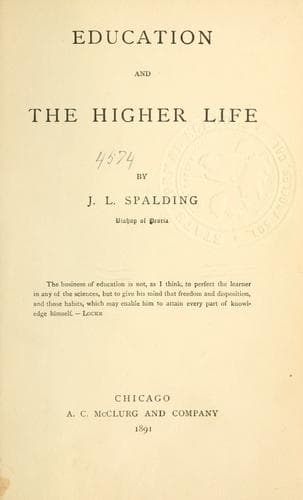
Education and the Higher LifeSpalding, John Lancaster
Religion
Education and the Higher Life
Spalding, John Lancaster
Education
things which concern their highest gifts, lose heart, turn away from
ideals, and abandon the pursuit of excellence. The nobler the mind, the
greater the danger of its being wrongly dealt with. We seldom find a man
whose thinking has helped to form opinion and to create literature, who,
if he care to say what he feels, will not declare that his scholastic
training was bad. Milton, Gray, Dryden, Wordsworth, Byron, Cowley,
Addison, Gibbon, Locke, Shelley, and Cowper had no love for the schools
to which they were sent; Swift and Goldsmith received no college honors;
and Pope, Thomson, Burns, and Shakespeare had little or nothing to do
with institutions of learning. A man educates himself; and the best work
teachers can do, is to inspire the love of mental exercise and a living
faith in the power of labor to develop faculty, and to open worlds of
use and delight which are infinite, and which each individual must
rediscover for himself. It is the educator's business to cherish the
aspirations of the young, to inspire them with confidence in themselves,
and to make them feel and understand that no labor can be too great or
too long, if its result be cultivation and enlightenment of mind. For
them ideals are real; their life is as yet wrapped in the bud; and to
encourage them to believe that if they are but true to themselves, the
flower and the fruit will be fair and health-bringing, is to open for
them the fountain of hope and noble endeavor.
What men have done, men can still do. Nay, shall we not rather believe
that the best is yet to be done? The peoples whom we call ancient were
but rude beginners. We are the true ancients, the inheritors of all the
wisdom and all the heroism of the past. We stand in a wider world, and
move forward with more conscious purpose along more open ways. Of the
past we see but the summits, illumined by the rays of genius and glory.
Could we look upon the plains where the multitudes lie in darkness,
wearing the triple chain of servitude, ignorance, and want, we should
understand how fair and beneficent our own age is. Enthusiasm for the
past cannot inspire the best intellectual work. The heart turns to the
past; but the mind looks to the future, and is forever untwisting the
cords which bind us to the things that pleased a childlike fancy. To
grow is to outgrow; and whatever of the past survives, survives, as the
very word implies, because it is still living and applicable here and
now. Let not the young believe that the age of the heroic and godlike is
gone. Good and the means of good are not harder to reconcile to-day than
they were a hundred or a thousand years ago, and they who have a heart
may now, as the best have done in the past, wring even from despair the
courage on which victory loves to smile. If we are weak and inferior the
fault lies in ourselves, not in the age. We are the age; and if we but
will and work, opportunities are offered us to become and to perform
whatever may crown and glorify a human soul.
Public-domain text, read in full here on John Shaqi.
Reviews
Reviews
No reviews yet
Be the first to share your thoughts on this work.
Join the Discussion
Join the discussion
Sign in to leave a comment or review.
Sign InorCreate an account