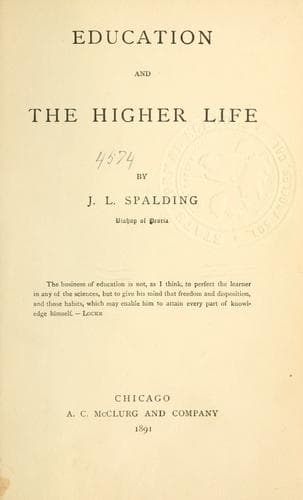
Education and the Higher LifeSpalding, John Lancaster
Religion
Education and the Higher Life
Spalding, John Lancaster
Education
But to enter upon such a course of life with well-founded hope of
success, we must be reverent and devout. The thrill of awe is, as Goethe
says, the best thing humanity has. We must understand and feel that the
visible is but the shadow of the invisible, that the soul has its roots
in God, whose kingdom is within us. We must perceive that what we know,
believe, admire, love, and yearn for makes our real life; that we are
worth what we _are_, and not what we possess and use. We must be lovers
of perfection, as the divine Saviour bids us become,--"Be ye perfect,
even as your Father in heaven is perfect." We must be conscious of the
immortal spirit which is ourself, and walk in the company of God and of
just men made perfect, striving after light and purity and strength,
which are of the soul. We must love the inward, the true, and the
eternal rather than the outward and transitory. We must believe that in
very truth we are akin to God, that God is in us, and we in him, and
consequently that it is our first duty to follow after perfection,
completeness of life, in thought, in love, and in conduct. As it is good
to know, so is it good to be strong, to be patient, to be humble, to be
helpful; so is it good to do right, though the deed should be our only
reward.
But we are beset by all manner of temptations to turn aside from a high
and noble way of living. The line of least resistance for us is the
common highway of money-getters and place-winners; and the moment a man
gives evidence of ability, the whole world urges him to put it to
immediate use. Our public opinion identifies the good with the useful,
all else is visionary and unreal. The average man controls us not only
in politics, but in religion, in art, and in literature. To turn away
from material good in order to gain spiritual and intellectual benefit
is held to be evidence of a feeble or perverted understanding. If a man
is eloquent, let him become a lawyer, a politician, or a preacher; if he
have a talent for science, let him become a physician, a practical
chemist, or a civil engineer; if he have skill in writing, let him
become a journalist or a contributor to magazines. No one asks himself,
What shall I do to gain wisdom, strength, virtue, completeness of life;
but the universal question is, How shall I make a living, get money,
position, notoriety? In our hearts we should rather have the riches of a
Rothschild than the mind of Plato, the imagination of Shakespeare, or
the soul of Saint Theresa. We believe the best is outside of us, that
the aids to the most desirable kind of life are to be found in material
and mechanical things. We talk with pride of our numbers, our
institutions, our machines; we love the display and noise of life, are
eager to mingle in crowds, to live in great cities, and to listen to
exaggerated and declamatory speech. The soberness of wisdom, the
humility of religion, the plainness of worth, are unattractive and
unrecognized.
Public-domain text, read in full here on John Shaqi.
Reviews
Reviews
No reviews yet
Be the first to share your thoughts on this work.
Join the Discussion
Join the discussion
Sign in to leave a comment or review.
Sign InorCreate an account