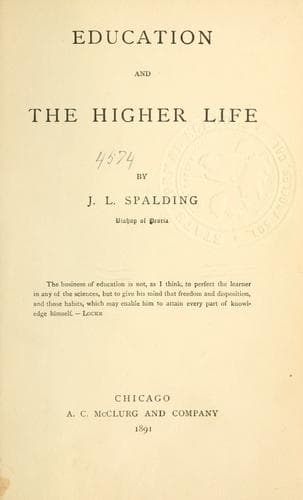
Education and the Higher LifeSpalding, John Lancaster
Religion
Education and the Higher Life
Spalding, John Lancaster
Education
We rush after material things, like hunters after game;
and in the excitement of the chase our pulse grows quick, and our vision
confused. We have lost the art of patient work and expectation. We are
no more capable of living in our work, of making it the means of our
growth and happiness. What we do, must be quickly done, must have
immediate results. Our success in solving the political and social
problems has spoiled us. When we hear of a man who has been prosperous
for years, whom no misfortune has sobered and softened, we expect him to
be narrow and supercilious; and in the same way, a prosperous people are
exposed to the danger of becoming self-complacent and superficial. We
exaggerate the importance of our own achievements and think that which
we have accomplished is the best; whereas the wise hold what they have
done in slight esteem, and think only of becoming themselves nobler and
wiser. Instead of boasting of our civilization, because we have
industrial and commercial prosperity, wealth and liberty, churches,
schools, and newspapers, we ought to ask ourselves whether civilization
does not imply something more and higher than this,--what kind of soul
lives and loves and thinks in this environment? Instead of trying to
persuade ourselves that we are the greatest and most enlightened people,
would it not be worth while to ask ourselves, in a dispassionate temper,
whether our best men and women are the most intellectual, the most
interesting, and the most Christian men and women to be found in the
world? Do they not lack repose, distinction, a sense for complete and
harmonious living? Must we not still look to Europe for our best
religious and philosophic thought, our best poetry, painting, music,
and architecture? "Let the passion for America," says Emerson, "cast out
the passion for Europe." This is desirable, but numbers and wealth will
not bring it about. While the best is said and done in Europe, the
better sort of Americans will look thither,--just as Europe looks to us
for corn and cotton, or mechanical appliances. We have done much, and
much that it was well to do. We have, as Matthew Arnold says, solved the
political and social problems better than any other people, though we
ourselves perceive that the solution is by no means final. The
conditions of our life are favorable to the many. It is easier for a man
to assert himself here, than it is or has ever been elsewhere. A little
sense, a little energy, is all that any one needs to make himself
independent and comfortable; and because success of this kind is so easy
it threatens to absorb our whole life. They alone seem to be living
worthily who are doing practical work, who are developing the natural
wealth of the country, starting new enterprises and inventing new
machines. The political problems which interest us are financial;
schools are maintained and fostered because they protect and strengthen
our institutions; religious beliefs are tolerated and encouraged because
Public-domain text, read in full here on John Shaqi.
Reviews
Reviews
No reviews yet
Be the first to share your thoughts on this work.
Join the Discussion
Join the discussion
Sign in to leave a comment or review.
Sign InorCreate an account