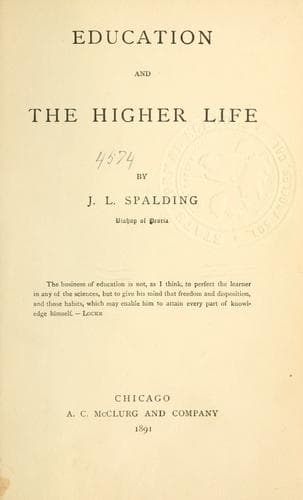
Education and the Higher LifeSpalding, John Lancaster
Religion
Education and the Higher Life
Spalding, John Lancaster
Education
they are aids to morality,--and morality means sobriety, honesty,
industry, which lead to thrift. Then there is an idea that religion is a
conservative power, useful as a bulwark against the assaults of
anti-social fanatics. Philosophy, poetry, and art are not considered
seriously, because they are not seen to bear any clear relation to our
institutions and temporal well-being. Opinion rules the wide world over;
and in the face of this strong public opinion which lays stress chiefly
upon external things,--the environment, the machinery of life,--and not
upon spiritual and intellectual qualities, it is not easy to love
knowledge and virtue for themselves, for the strength and beauty they
give to the soul, for their power to build up the being which is a man's
very self. It is rare that men have faith in what but few believe in;
they are gregarious, and need the encouragement that comes of having
aims and hopes of which the millions approve.
The predominance of the average man, of which our public opinion is the
result, puts other obstacles in the way of culture. It makes us
self-complacent, easily satisfied with what we perform. A representative
man will become a lawyer, a soldier, a merchant, a legislator, an
author, in turns, as occasion offers, and he has no doubt of his
sufficiency; because average work is all that is expected of any one. To
be able to do anything fairly well seems to us a more desirable
accomplishment than to be able to do some one thing better than anybody
else. But this is a view which only those may take who live in an
imperfectly developed society. As men become more cultivated, they more
and more want only the best; and the noblest natures feel the desire to
do their best, not with their actual power, but with the skill which
forty or fifty years of discipline and effort might give them. They are
laborious; they are patient; they persevere in one direction; they
believe that if they but continue to observe, to think, to read, to
compare, and to express in plain words what they know, their power of
seeing and of uttering will continue to grow. The charm of increasing
faculty in an infinite world sways and controls them. They never know
enough; they are never able to say well enough what they know; and so
they grow old still learning many things. They work in a spirit wholly
different from that of the common man, who if he get through with what
he has in hand is satisfied. They have an artist's sense of perfection;
and like Virgil would burn the works which if they once escape their own
hands, the world will never permit to perish.
Public-domain text, read in full here on John Shaqi.
Reviews
Reviews
No reviews yet
Be the first to share your thoughts on this work.
Join the Discussion
Join the discussion
Sign in to leave a comment or review.
Sign InorCreate an account