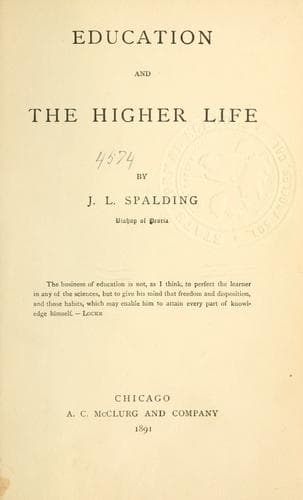
Education and the Higher LifeSpalding, John Lancaster
Religion
Education and the Higher Life
Spalding, John Lancaster
Education
It is our indolence and frivolity that make routine duties, however
distracting or importunate, incompatible with the serious application
which the work of self-culture demands; but we are by nature indolent
and frivolous, and only education can make us earnest and laborious.
None but a cultivated mind can understand that if the whole human race
could be turned loose, to eat and drink and play like thoughtless
children, life would become meaningless; that a paradise in which work
should not be necessary would become wearisome. The progress of the race
is the result of effort, physical, religious, moral, and intellectual;
and the advance of individuals is proportional to their exertion. Nature
herself pushes the young to bodily exercise; but though activity is for
them a kind of necessity, only the discipline of habit will lead them to
prefer labor to idleness; and they will not even use their senses
properly unless they are taught to look and to listen,--just as they are
taught to walk and to ride. The habit of manual labor, as it is directly
related to the animal existence to which man is prone, and supplies the
physical wants whose urgency is most keenly felt, is acquired with least
difficulty, and it prepares the way for moral and intellectual life; but
it especially favors the life which has regard to temporal ends and
conduces to comfort and well-being. They whose instrument is the brain
rarely aim at anything higher than wealth and position; and if they
become rich and prominent, they remain narrow and uninteresting. They
talk of progress, of new inventions and discoveries, and they neglect to
improve themselves; they boast of the greatness of their country, while
their real world is one of vulgar thought and desire; they take interest
in what seems to concern the general welfare, but fail to make
themselves centres of light and love. What is worse they have the
conceit of wisdom,--they lack reverence; they are impatient, and must
have at once what they seek. But the better among us see the
insufficiency of the popular aims, and begin to yearn for something
other than a life of politics, newspapers, and financial enterprise.
They desire to know and love the best that is known, and they are
willing to be poor and obscure, if they may but gain entrance into this
higher world. "I shall ever consider myself," says Descartes, "more
obliged to those who leave me to my leisure, than I should to any who
might offer me the most honorable employments." This is the thought of
every true student and lover of wisdom; for he feels that whatever a
man's occupation may be, his business is to improve his mind and to form
his character. He desires not to be known and appreciated, but to know
and appreciate; not to _have_ more, but to _be_ more; not to have
friends, but to be the friend of man,--which he is when he is the lover
of truth. He turns from vulgar pleasures as he turns from pain, because
Public-domain text, read in full here on John Shaqi.
Reviews
Reviews
No reviews yet
Be the first to share your thoughts on this work.
Join the Discussion
Join the discussion
Sign in to leave a comment or review.
Sign InorCreate an account