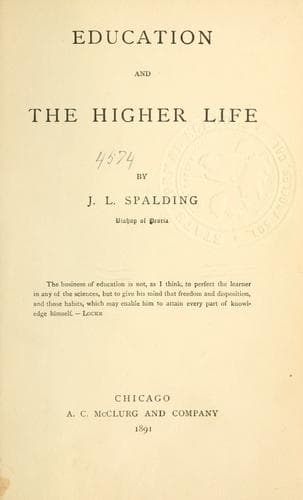
Education and the Higher LifeSpalding, John Lancaster
Religion
Education and the Higher Life
Spalding, John Lancaster
Education
both pleasure and pain in fastening the soul to the body deprive it of
freedom and hinder the play of the mind.
He loves the best with single heart
And without thought what gifts it bring.
Unless one have deep faith in the good of culture he will easily become
discouraged in the work which is here urged upon him. He must be drawn
to the love of intellectual excellence by an attraction such as a poet
feels in the presence of beauty; he must believe in it as a miser
believes in gold; he must seek it as a lover seeks the beloved. Our
wants determine our pleasures, and they who have no intellectual
cravings feel not the need of exercise of mind. They are born and remain
inferior. They are content with the world which seems to be real,
forgetting the higher one, which alone is real; they are not urged to
the intellectual life by irresistible instincts. They are discouraged by
difficulties, thwarted by obstacles which lie in the path of all who
strive to move forward and to gain higher planes. It is not possible to
advance except along the road of toil, of struggle, and of suffering.
We cannot emerge even from childish ignorance and weakness without
experiencing a sense of loss. Mental work in the beginning and for a
long time is weariness, is little better than drudgery. We labor, and
there seems to be no gain; we study and there seems to be no increase of
knowledge or power; and if we persevere, we are led by faith and hope,
not by any clear perception of the result of persistent application.
Genius itself is not exempt from this law. Poets and artists work with
an intensity unknown to others, and are distinguished by their faith in
the power of labor. The consummate musician must practice for hours, day
by day, year in and year out. The brain is the most delicate and the
finest of instruments, and it is vain to imagine that anything else than
ceaseless, patient effort will enable us to use it with perfect skill;
indeed, it is only after long study that we become capable of
understanding what the perfection of the intellect is, that we become
capable of discerning what is excellent, beautiful, and true in style
and thought.
Public-domain text, read in full here on John Shaqi.
Reviews
Reviews
No reviews yet
Be the first to share your thoughts on this work.
Join the Discussion
Join the discussion
Sign in to leave a comment or review.
Sign InorCreate an account