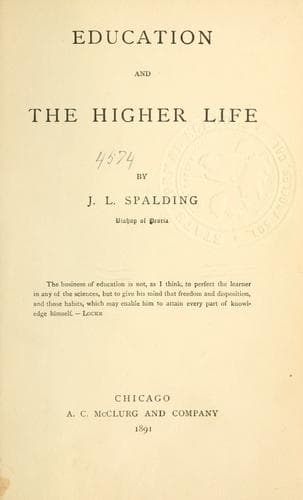
Education and the Higher LifeSpalding, John Lancaster
Religion
Education and the Higher Life
Spalding, John Lancaster
Education
Discouragement and weariness will, again and again, suggest doubts
concerning the wisdom of this ceaseless effort to improve one's self.
Why persist in the pursuit of what can never be completely attained?
Why toil to gain what the mass of men neither admire nor love? Why wear
out life in a course of action which leads neither to wealth nor honors?
Why turn away from pleasures which lie near us to follow after ideal
things? These are questions which force themselves upon us; and it
requires faith and courage not to be shaken by this sophistry. Visions
of ideal life float before young eyes, and if to be attracted by what is
high and fair were enough, it were not difficult to be saint, sage, or
hero; but when we perceive that the way to the best is the road of toil
and drudgery, that we must labor long and accomplish little, wander far
and doubt our progress, must suffer much and feel misgivings whether it
is not in vain,--then only the noblest and the bravest still push
forward in obedience to inward law. The ideal of culture appeals to them
with irresistible force. They consent to lack wealth, and the approval
of friends and the world's applause; they are willing to turn away when
fair hands hold out the cup of pleasure, when bright eyes and smiling
lips woo to indulgence. If, you ask, How long? They answer, Until we
die! They are lovers of wisdom and do not trust to hope of temporal
reward. Their aim is light and purity of mind and heart; these they
would not barter for comfort and position. As saints, while doing the
common work of men, walk uplifted to worlds invisible, so they, amid the
noise and distractions of life still hear the appealing voice of truth;
and as parted lovers dream only of the hour when they shall meet again,
so these chosen spirits, in the midst of whatever cares and labors, turn
to the time when thought shall people their solitude as with the
presence of angels. They hear heavenly voices asking, Why stay ye on the
earth, unless to grow? Vanity, frivolity, and fickleness die within
them; and they grow to be humble and courageous, disinterested and
laborious, strong and persevering. The cultivation of their higher
nature becomes the law of their life; and the sense of duty, "stern
daughter of the voice of God," which of all motives that sway the heart,
best stands the test of reason, becomes their guide and support. Thus
culture, which looks to the Infinite and All-wise as to its ideal, rests
upon the basis of morality and religion.
Public-domain text, read in full here on John Shaqi.
Reviews
Reviews
No reviews yet
Be the first to share your thoughts on this work.
Join the Discussion
Join the discussion
Sign in to leave a comment or review.
Sign InorCreate an account