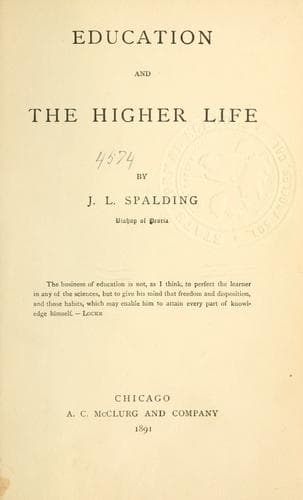
Education and the Higher LifeSpalding, John Lancaster
Religion
Education and the Higher Life
Spalding, John Lancaster
Education
"But in despite
Of all this outside bravery, within
He neither felt encouragement nor hope;
For moral dignity and strength of mind
Were wanting, and simplicity of life
And reverence for himself; and, last and best,
Confiding thoughts, through love and fear of Him
Before whose sight the troubles of this world
Are vain."
The corrupt and the ignorant easily learn to feel contempt, but the
scholar is reverent. He moves in the midst of infinite worlds, and knows
that the least is part of the whole.
Now, how shall he who is resolved to educate himself set about his work?
What advice shall be given him? What rules shall be made for him that he
may not waste time and energy? He who yearns for the cultivation of mind
which makes wisdom possible must work his way to the light. All
intellectual men strive to educate themselves, but each one strives in a
different way. They all aim at insight rather than information, at the
perfect use of their faculties rather than learning. The power to see
things as they are, is what they want; and therefore they look, observe,
examine, compare, analyze, meditate, read, and write. And they keep
doing this day by day; and the longer they work, the more attractive
their work grows to be. Descartes, who is a typical lover of the
intellectual life, looked upon himself simply as a thinking being, and
gave all his thought to the cultivation of his higher faculties in the
hope that he might finally discover some truth which would bring
blessings to men. He had no thought of literary fame, published little,
and sedulously avoided whatever might bring him into notoriety. "Those,"
he says, "who wish to know how to speak of everything and to acquire a
reputation for learning, will succeed most easily if they content
themselves with the semblance of truth, which may readily be found." The
love of truth is the mark of the real student. What is, is; it is man's
business to know it. He is the foe of pretense; sham for him means
shame. He will have sound knowledge; he will do his work well; whether
men shall applaud or reward him for it, is a foreign consideration. He
obeys an inward law, and the praise of those who cannot understand him
sounds to him like mockery. True thought, like right conduct, is its own
reward. To see truth and to love it is enough,--is more than to have the
worship of the world. The important thing is to be a man, to have a
serious purpose, to be in earnest, to yearn for what is good and holy;
and without this the culture of the intellect will not avail.
Public-domain text, read in full here on John Shaqi.
Reviews
Reviews
No reviews yet
Be the first to share your thoughts on this work.
Join the Discussion
Join the discussion
Sign in to leave a comment or review.
Sign InorCreate an account