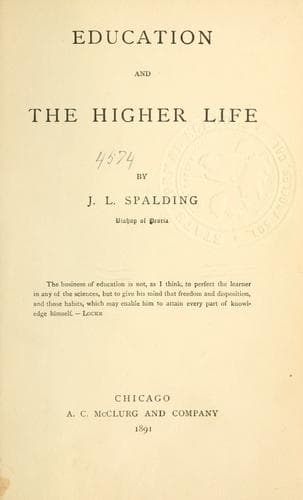
Education and the Higher LifeSpalding, John Lancaster
Religion
Education and the Higher Life
Spalding, John Lancaster
Education
We must build upon the broad foundation of man's life, and not upon any
special faculty. The merely literary man is often the most pitiful of
men,--able, it may be, to do little else than complain that his merits
are not recognized. Let it not be imagined then that the lover of
wisdom, the follower of intellectual good, should propose to himself a
literary career. He may of course be or become a man of letters, but
this is incidental to his life-purpose, which is to develop within
himself the power of knowing and loving. He will learn to think rightly
and to act well, first of all; for he knows that a man's writing cannot
be worth more than he himself is worth. He is a seeker after truth and
perfection; and understanding at the price of what countless labors
these may be hoped for, he is slow to imagine that words of his may be
of help to others.
Observation, reading, and writing are the chief means by which thought
is stimulated, the mind developed, and the intellect cultivated. The
habit of looking and the habit of thinking are closely related. A man
thinks as he sees; and for a mind like Shakespeare's, for instance,
observation is almost the only thing that is necessary for its
development. The boundless world breaks in upon him with creative force.
His sympathy is universal, and therefore so is his interest. He sees the
like in the unlike, the differences in things which are similar. Every
little bird and every little flower are known to him. He contemplates
Falstaff and Poor Tom with as much interest as though they were Hamlet
and King Lear. In all original minds the power of observation is great.
It is the chief source of our earliest knowledge, of that which touches
us most nearly and most deeply colors the imagination. When the boy is
wandering through fields, sitting in the shade of trees, or lying on the
banks of murmuring streams, he is not only learning more delightful
things than books will ever teach him, but he is also acquiring the
habit of attention, of looking at what he sees, which nowhere else can
be gotten in so natural and pleasant a way. Hence the best minds have
either been born in the country or have passed there some of their early
years. Unless we have first learned to look with the eye, we shall never
learn to look with the mind. They who walk unmoved beneath the starlit
heavens, or by the ever-moving ocean, or amid the silent mountains; who
do not find, like Wordsworth, that the meanest flower that blows gives
thoughts which often lie too deep for tears, will not derive great help
from the world of books. But in the world of books the intellectual must
also make themselves at home and live, must thence draw nourishment,
light, wisdom, strength, for there as nowhere else the mind of man has
stamped its image; and there the thoughts of the master spirits still
breathe, still glow with truth and beauty. The best books are powers
Public-domain text, read in full here on John Shaqi.
Reviews
Reviews
No reviews yet
Be the first to share your thoughts on this work.
Join the Discussion
Join the discussion
Sign in to leave a comment or review.
Sign InorCreate an account