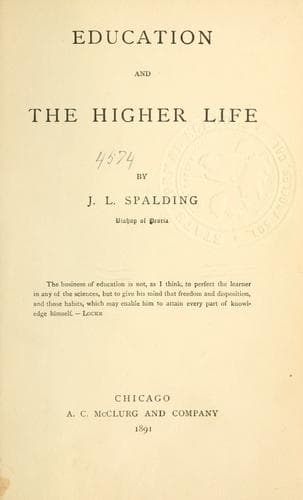
Education and the Higher LifeSpalding, John Lancaster
Religion
Education and the Higher Life
Spalding, John Lancaster
Education
"Forever to be hallowed; only less,
For what we are and what we may become,
Than Nature's self, which is the breath of God,
Or his pure Word, by miracle revealed."
But it is as difficult to know books as to know men. There are but few
men who can be of intellectual service to us; and there are but few
books which stimulate and nourish the mind. The best books are, as
Milton says, "the precious life-blood of a master spirit;" and it is
absurd to suppose that they will reveal their secret to every chance
comer, to every heedless reader. As it takes a hero to know a hero, so
only an awakened mind can love and understand the great thinkers. The
reading of the ignorant is chiefly a mechanical proceeding; and, indeed,
for men in general reading is little better than waste of time. Their
reading, like their conversation, leaves them what they were, or worse.
The mass of printed matter has no greater value from an intellectual
point of view at least than the wide ever-flowing stream of talk; and
for the multitude it is all the same whether they gossip and complain,
or read and nod. However much they read, they remain unintelligent; what
knowledge they gain is fragmentary, unreal; they learn merely enough to
talk about what they do not understand. We may of course read for
entertainment, as we may talk for entertainment; but this is merely a
recreation of the mind, which is good only because it rests and prepares
us for work. The wise read books to be enlightened, uplifted, and
inspired. Their reading is a labor in which every faculty of the mind
is awake and active. They are attentive; they weigh, compare, judge.
They re-create within their own minds the images produced by the author;
they seek to enter into his inmost thought; they admire each well-turned
phrase, each happy epithet; they walk with him, and make themselves at
home in the wonderland which his genius has called into being; past
centuries rise before them, and they almost forget that they did not
hear Plato discourse in the Academy, or stroll with Horace along the
Sacred Way. As they are brought thus intimately into the company of the
noblest minds, they think as they thought, feel as they felt, and so are
enlightened and inspired. They drink the spirit of the mighty dead, and
gradually come to live in a higher and richer world. The best in life
and literature is seen to be such only by those who have made themselves
worthy of the heavenly vision; and once we have learned to love the few
real books of the world, or rather what in these few is eternally true
and beautiful, we breathe the atmosphere of the intellectual life. What
is frivolous, or false, or vulgar can no longer please us; having seen
and loved what is high we may not sink to the lower.
Public-domain text, read in full here on John Shaqi.
Reviews
Reviews
No reviews yet
Be the first to share your thoughts on this work.
Join the Discussion
Join the discussion
Sign in to leave a comment or review.
Sign InorCreate an account