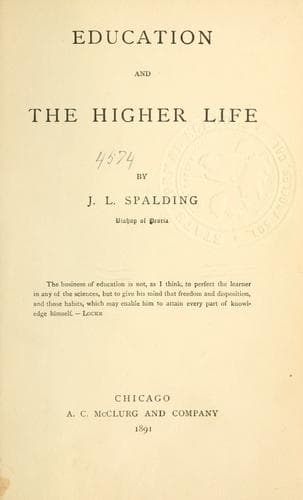
Education and the Higher LifeSpalding, John Lancaster
Religion
Education and the Higher Life
Spalding, John Lancaster
Education
politics and society.
Whatever we may think of the past, whatever we may fear or hope for the
future, if we would make an impression on the world around us, we must
understand the thoughts, the purposes, and the methods of those with
whom we live; and we must at the same time recognize that though the
truth of religion be unchangeable, the mind of man is not so, and that
the point of view varies not only from people to people, and from age to
age, but from year to year in the growing thought of the individual and
of the world. As in travelling round the earth, time changes, and when
it is morning here, it is evening there, so with difference of latitude
and longitude, of civilization and barbarism, the opinions and manners
of men grow different. They who observe from positions widely separate
do not see the same things, or do not see them in the same light. Proof
for a peasant is not proof for a philosopher; and arguments which in one
age are held to be unanswerable, in another lose power to convince, or
become altogether meaningless. It is not to be imagined that the hearts
of Christians should again burn with the devotional enthusiasm and the
warlike ardor of the Crusaders; and just as little is it conceivable
that men should again become passionately interested in the questions
which in the fourth and fifth centuries filled the world with the noise
of theological disputation. It were mere loss of time to beat now the
waste fields of the Protestant controversy. Wiseman's book on science
and revealed religion, which fifty years ago attracted attention, lies
like a stranded ship on a deserted shore, and attempts of the kind are
held in slight esteem. The immature mind is eager to reduce faith to
knowledge; but the accomplished thinker understands that knowledge
begins and ends in faith. There is oppugnancy between belief in an
all-wise, all-good, and all-powerful God, and belief in the divine
origin of Nature, whose face is smeared with filth and blood; but we
hold that the conflicting faiths and increasing knowledge cannot add to
the difficulty. On the contrary, the higher the intelligence, the purer
Nature seems to grow. The chemical elements are as fair and sweet in the
corpse as in the living body, and the earthquake and the cyclone obey
the same laws which make the waters flow and the zephyrs breathe
perfume. It is the imagination and not the reason that is overwhelmed by
the idea of unending space and time. To the intellect, eternity is not
more mysterious than the present moment, and the distance which
separates us from the remotest stars is not more incomprehensible than a
hand's breadth. Science is the widening thought of man, working on the
hypothesis of universal intelligibility toward universal intelligence;
and religion is the soul, escaping from the labyrinth of matter to the
light and love of the Infinite; and on the heights they meet and are at
peace.
Public-domain text, read in full here on John Shaqi.
Reviews
Reviews
No reviews yet
Be the first to share your thoughts on this work.
Elsewhere in the archive
Join the Discussion
Join the discussion
Sign in to leave a comment or review.
Sign InorCreate an account