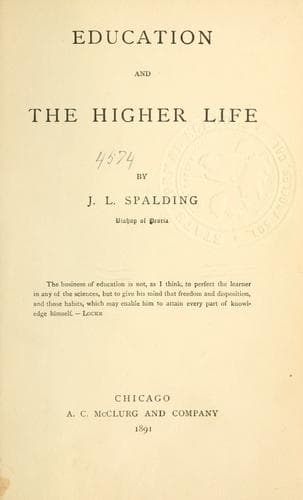
Education and the Higher LifeSpalding, John Lancaster
Religion
Education and the Higher Life
Spalding, John Lancaster
Education
Meanwhile they who seek natural knowledge must admit that faith, hope,
and love are the everlasting foundations of human life, and that a
philosophic creed is as sterile as Platonic love; and they who uphold
religion must confess that faith which ignorance alone can keep alive
is little better than superstition. To strive to attain truth under
whatever form is to seek to know God; and yet no ideal can be true for
man, unless it can be made to minister to faith, hope, and love; for by
them we live. Let us then teach ourselves to see things as they are,
without preoccupation or misgivings lest what is should ever make it
impossible, for us to believe and hope in the better yet to be. Science
and morality need religion as much as thought and action require
emotion; and beyond the utmost reach of the human mind lie the boundless
worlds of mystery where the soul must believe and adore what it can but
dimly discern. The Copernican theory of the heavens startled believers
at first; but we have long since grown accustomed to the new view which
reveals to us a universe infinitely more glorious than aught the
ancients ever imagined. We do not rightly see either the things which
are always around us, or those which for the first time are presented to
our eyes; and when novel theories of the visible world, which in some
sense is part of our very being, profoundly alter our traditional
notions, the mind is disturbed and overclouded, and the lapse of time
alone can make plain the real bearing of the new learning upon life,
upon religion, and upon society. There can be no doubt but increase of
knowledge involves incidental evils, just as the progress of
civilization multiplies our wants; but the wise are not therefore driven
to seek help from ignorance and barbarism. Whatever the loss, all
knowledge is gain. The evils that spring from enlightenment of mind will
find their remedy in greater enlightenment. Such at least is the faith
of an age whose striking characteristic is confidence in education. Men
have ceased to care for the bliss there may be in ignorance, and those
who dread knowledge, if such there still be, are as far away from the
life of this century as the dead whose bones crumbled to dust a thousand
years ago.
The aim the best now propose to themselves is to provide not wealth or
pleasure, or better machinery or more leisure, but a higher and more
effective kind of education; and hence whatever one's preoccupation,
whether social, political, religious, or industrial, the question of
education forces itself upon his attention. Pedagogy has grown to be a
science, and chairs are founded in universities to expound the theory
and art of teaching. The learning of former times has become the
ignorance of our own; and the classical writings have ceased to be the
treasure-house of knowledge, and in consequence their educational value
has diminished.
Public-domain text, read in full here on John Shaqi.
Reviews
Reviews
No reviews yet
Be the first to share your thoughts on this work.
Elsewhere in the archive
Join the Discussion
Join the discussion
Sign in to leave a comment or review.
Sign InorCreate an account