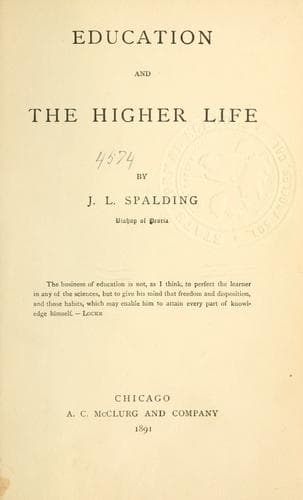
Education and the Higher LifeSpalding, John Lancaster
Religion
Education and the Higher Life
Spalding, John Lancaster
Education
Whoever three hundred years ago wished to acquaint himself with
philosophic, poetic, or eloquent expression of the best that was known,
was compelled to seek for it in the Greek and Latin authors; but now
Greek and Latin are accomplishments chiefly, and a classical scholar, if
unacquainted with modern science and literature, is hopelessly ignorant.
"If any one," said Hegius, the teacher of Erasmus, "wishes to learn
grammar, rhetoric, mathematics, history, or holy scripture, let him read
Greek;" and in his day this was as true as it is false and absurd in our
own. In the Middle Ages, Latin was made the groundwork of the
educational system, not on account of any special value it may have been
supposed to possess as a mental discipline, but because it was the
language of the learned, of all who spoke or wrote on questions of
religion, philosophy, literature, and science; but now, who that is able
to think dreams of burying his thought in a Greek or Roman urn? The
Germans in philosophy, the English in poetry, have surpassed the Greeks;
and French prose is not inferior in qualities of style to the ancient
classics, and in wealth of thought and knowledge so far excels them as
to preclude comparison.
The life of Greece and Rome, compared with ours, was narrow and
superficial; their ideas of Nature were crude and often grotesque; they
lacked sympathy; the Greek had no sense of sin; the Roman none of the
mercy which tempers justice. In their eyes the child was not holy, woman
was not sacred, the slave was not man. Their notion of liberty was
political and patriotic merely; the human soul, standing forth alone,
and appealing from States and emperors to the living God, was to them a
scandal. Now literature is the outgrowth of a people's life and thought,
and the nobler the life, the more enlightened the thought, the more
valuable will the expression be; and since there is greater knowledge,
wisdom, freedom, justice, mercy, goodness, power, in Christendom now
than ever existed in the pagan world, it would certainly be an anomaly
if modern literature were inferior to the classical. The ancients,
indeed, excel us in the sense for form and symmetry. There is also a
freshness in their words, a joyousness in their life, a certain heroic
temper in their thinking and acting, which give them power to engage the
emotions; and hence to deny them exceptional educational value is to
take a partial view. But even though we grant that the study of their
literatures is in certain respects the best intellectual discipline,
education, it must be admitted, means knowledge as well as training; and
thorough training is something more than refined taste. It is strength
as well, and ability to think in many directions and on many subjects.
Nothing known to men should escape the attention of the wise; for the
knowledge of the age determines what is demanded of the scholar. And
since it is our privilege to live at a time when knowledge is increasing
Public-domain text, read in full here on John Shaqi.
Reviews
Reviews
No reviews yet
Be the first to share your thoughts on this work.
Elsewhere in the archive
Join the Discussion
Join the discussion
Sign in to leave a comment or review.
Sign InorCreate an account