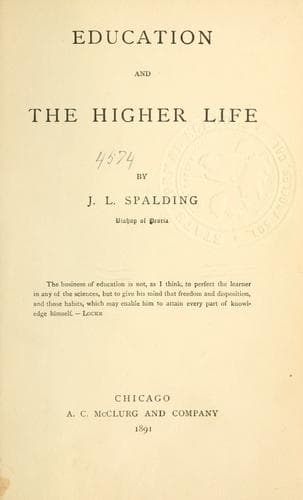
Education and the Higher LifeSpalding, John Lancaster
Religion
Education and the Higher Life
Spalding, John Lancaster
Education
more rapidly even than population and wealth, we must, if we hope to
stand in the front ranks of those who know, keep pace with the onward
movement of mind. To turn away from this outburst of splendor and power;
to look back to pagan civilization or Christian barbarism,--is to love
darkness more than light. Aristotle is a great mind, but his learning is
crude and his ideas of Nature are frequently grotesque. Saint Thomas is
a powerful intellect; but his point of view in all that concerns natural
knowledge has long since vanished from sight. What poverty of learning
does not the early medieval scheme of education reveal; and when in the
twelfth century the idea of a university rises in the best minds, how
incomplete and vague it is! Amid the ruins of castles and cathedrals we
grow humble, and think ourselves inferior to men who thus could build.
But they were not as strong as we, and they led a more ignorant and a
blinder life; and so when we read of great names of the past, the mists
of illusion fill the skies, and our eyes are dimmed by the glory of
clouds tinged with the splendors of a sun that has set.
Certainly a true university will be the home both of ancient wisdom and
of new learning; it will teach the best that is known, and encourage
research; it will stimulate thought, refine taste, and awaken the love
of excellence; it will be at once a scientific institute, a school of
culture, and a training ground for the business of life; it will educate
the minds that give direction to the age; it will be a nursery of ideas,
a centre of influence. The good we do men is quickly lost, the truth we
leave them remains forever; and therefore the aim of the best education
is to enable students to see what is true, and to inspire them with the
love of all truth. Professional knowledge brings most profit to the
individual; but philosophy and literature, science and art, elevate and
refine the spirit of the whole people, and hence the university will
make culture its first aim, and its scope will widen as the thoughts and
attainments of men are enlarged and multiplied. Here if anywhere shall
be found teachers whose one passion is the love of truth, which is the
love of God and of man; who look on all things with a serene eye; who
bring to every question a calm, unbiased mind; who, where the light of
the intellect fails, walk by faith and accept the omen of hope; who
understand that to be distrustful of science is to lack culture, to
doubt the good of progress is to lack knowledge, and to question the
necessity of religion is to want wisdom; who know that in a God-made and
God-governed world it must lie in the nature of things that reason and
virtue should tend to prevail, in spite of the fact that in every age
the majority of men think foolishly and act unwisely. How divine is not
man's apprehensive endowment! When we see beauty fade, the singer lose
her charm, the performer his skill, we feel no commiseration; but when
Public-domain text, read in full here on John Shaqi.
Reviews
Reviews
No reviews yet
Be the first to share your thoughts on this work.
Elsewhere in the archive
Join the Discussion
Join the discussion
Sign in to leave a comment or review.
Sign InorCreate an account