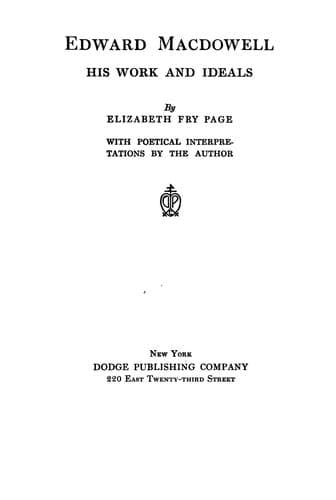
Edward MacDowell, His Work and Ideals — John Shaqi
Edward MacDowell, His Work and IdealsPage, Elizabeth Fry
General
Edward MacDowell, His Work and Ideals
Page, Elizabeth Fry
MacDowell, Edward, 1860-1908
Within, the personality of the absent composer lingers perceptibly,
and the two names--"Edward--Marian-1899"--written in his bold
chirography in the damp cement, when the cabin hearth was laid before
the open fireplace, tell a touching story of a union so real as to
make no plan complete, no realization of a long-cherished hope
perfect, that did not openly include his wife.
These two were married in New York in 1884. A gifted South Carolina
aunt, who went to New York after the war and soon made her way to the
front rank of metropolitan teachers, gave to Marian Nevins, a
country-bred girl of York State, the only musical training she ever
had until she went abroad in 1880 to pursue her studies. Edward
MacDowell was at that time in high favor with his masters, Heymann and
Raff, at the Frankfort Conservatory, and she became his pupil. Her
industry and ambition aroused his interest in the development of her
talent, and he put her through a long season of severe drill and
study, imparting to her all his original methods and personal ideals,
as well as those acquired from his masters. It was hard work between
the gifted teacher and his promising pupil, with no idea of romance;
but with her preparations for her return to America, at the expiration
of three years, came the revelation to each of the meaning of the
impending separation, and in a twelvemonth after her departure he went
to New York and returned to Germany with his bride, settling at
Wiesbaden, where they spent some ideal years. While he began his
career as a composer in that inspiring atmosphere and won a hearing
and a verdict that opened the way to fame, it was after his return to
America that he did his best work, when he freed himself from the
chance of unconscious imitation and reflection and gave rein to
individuality and imagination in the Peterboro retreat. Weber says:
"To be a true artist you must be a true man." This tribute has been
paid MacDowell by his associates: they say he was a true man.
Nobleness has been called the chief characteristic alike of himself
and his music, with a simplicity that is ever the accompaniment of
real nobility. In playing, he had certain little tricks of using his
fingers that produced certain effects, but he did not teach these to
his pupils, preferring that they should use their own ingenuity,
explaining: "You might find a better way than mine," showing a modest
willingness to be taught, even by his own pupils, instead of always
posing as master. He never forced his personality, as a man or as a
musician, upon any one, choosing rather to encourage and foster
originality.
Public-domain text, read in full here on John Shaqi.
Reviews
Reviews
No reviews yet
Be the first to share your thoughts on this work.
Join the Discussion
Join the discussion
Sign in to leave a comment or review.
Sign InorCreate an account