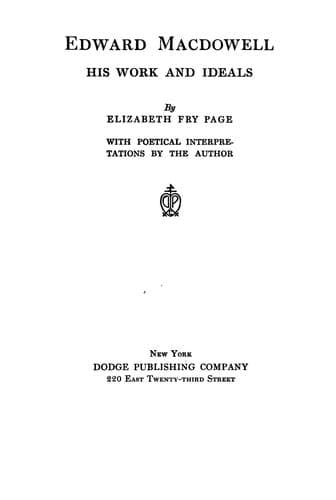
Edward MacDowell, His Work and IdealsPage, Elizabeth Fry
General
Edward MacDowell, His Work and Ideals
Page, Elizabeth Fry
MacDowell, Edward, 1860-1908
His good angel must have led Edward MacDowell to Peterboro. I can
imagine no other setting so perfect for the last act of his life, with
its shifting scenes. Whatever else the great power back of the
universe may be, He is the Master Artist, and in the making of this
village of enchantment He seems to have gathered together all His most
beautiful materials and combined them with lavish hand. Quaint and
picturesque houses are sprinkled over the foot-hills of the Monadnock
Mountains. Green fields go down to meet clear streams of placid water,
where trailing vines and overhanging boughs make charming shadows. The
sun sparkles against great gray boulders, lichen-grown, and upon
yellow sand dunes. There are pines, larches, firs, spruces and all
their sturdy kinspeople, scattered freely that the eye may at any
season be gladdened by the sight of living green, and interspersed
with these are deciduous trees of every kind, to make a fantastic
tracery of bare branches against the wintry sky and furnish a series
of beautiful contrasts, from the earliest tender bud to the last sere
autumn leaf. And the ferns! Did the Great Artist have any left after
planting the fence-corners, roadsides and deep woods of Peterboro?
Overarch these features with a fair dome of fleece-scattered blue and
waft abroad throughout the place a succession of mountain breezes,
ozone charged, and you have a place to live and work and grow young
in.
MacDowell thought that the fine arts were supplemental, each of the
other, and wished to include them all in his scheme, so well-built
rustic studios, equipped to suit the needs of the occupant, are being
placed at intervals on advantageous sites in the woods, tree-screened
and far enough apart to insure quiet and privacy, but sufficiently
near to give that comfortable sense of human comradeship and safety.
There is a common domicile at the foot of "Hill Crest," called "The
Lower House," presided over by a capable housekeeper, where the
workers sleep, breakfast, dine and recreate in the evening; but after
breakfast, provided with a simple lunch, each hies away happily to his
own studio to spend the day in alternate working and waiting on the
Muses in blissful solitude. This routine is broken sufficiently by
cups of tea with Mrs. MacDowell at "Hill Crest," rambles in garden and
wood, drives over the picturesque mountain roads and tramps to the
village, to prevent Jack from having any chance of becoming a dull
boy.
The departed musician's own log cabin, already referred to as the
place where most of his later works were composed, was the first of
the studios to be built, and it would be difficult to imagine a more
perfect retreat for his purpose.
"It looks out over the whispering treetops,
And faces the setting sun,"
which glints on the bark roof, now covered with a thick shower of
fragrant brown pine needles, giving the appearance of a pre-designed
thatch.
Public-domain text, read in full here on John Shaqi.
Reviews
Reviews
No reviews yet
Be the first to share your thoughts on this work.
Join the Discussion
Join the discussion
Sign in to leave a comment or review.
Sign InorCreate an account