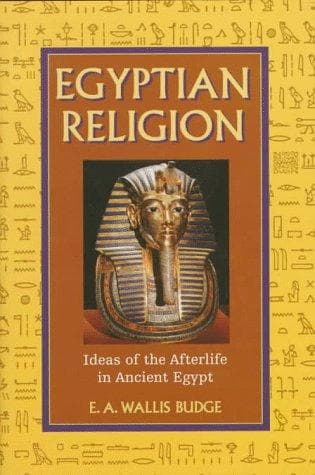
Egyptian Ideas of the Future LifeBudge, E. A. Wallis (Ernest Alfred Wallis), Sir
ReligionComparative
Egyptian Ideas of the Future Life
Budge, E. A. Wallis (Ernest Alfred Wallis), Sir
Egypt -- Religion; Eschatology, Egyptian; Future life
The same idea of God, but considerably amplified in some respects, may
be found in the _Maxims of Khensu-Hetep_, a work which was probably
composed during the XVIIIth dynasty. This work has been studied in
detail by a number of eminent Egyptologists, and though considerable
difference of opinion has existed among them in respect of details and
grammatical niceties, the general sense of the maxims has been clearly
established. To illustrate the use of the word _neter_, the following
passages have been chosen from it:[Footnote: They are given with
interlinear transliteration and translation in my _Papyrus of Ani_, p.
lxxxv. ff., where references to the older literature on the subject will
be found.]--
1. "God magnifieth his name."
2. "What the house of God hateth is much speaking. Pray thou with a
loving heart all the petitions which are in secret. He will perform
thy business, he will hear that which thou sayest and will accept
thine offerings."
3. "God decreeth the right."
4. "When thou makest an offering unto thy God, guard thou against the
things which are an abomination unto him. Behold thou his plans with
thine eye, and devote thyself to the adoration of his name. He giveth
souls unto millions of forms, and him that magnifieth him doth he
magnify."
5. "If thy mother raise her hands to God he will hear her prayers [and
rebuke thee]."
7. "Give thyself to God, and keep thou thyself daily for God."
Now, although the above passages prove the exalted idea which the
Egyptians held of the supreme Being, they do not supply us with any of
the titles and epithets which they applied to him; for these we must
have recourse to the fine hymns and religious meditations which form so
important a part of the "Book of the Dead." But before we quote from
them, mention must be made of the _neteru_, _i.e._, the beings or
existences which in some way partake of the nature or character of God,
and are usually called "gods." The early nations that came in contact
with the Egyptians usually misunderstood the nature of these beings, and
several modern Western writers have done the same. When we examine these
"gods" closely, they are found to be nothing more nor less than forms,
or manifestations, or phases, or attributes, of one god, that god being
R[=a] the Sun-god, who, it must be remembered, was the type and symbol
of God. Nevertheless, the worship of the _neteru_ by the Egyptians has
been made the base of the charge of "gross idolatry" which has been
brought against them, and they have been represented by some as being on
the low intellectual level of savage tribes. It is certain that from the
earliest times one of the greatest tendencies of the Egyptian religion
was towards monotheism, and this tendency may be observed in all
important texts down to the latest period; it is also certain that a
kind of polytheism existed in Egypt side by side with monotheism from
very early times.
Public-domain text, read in full here on John Shaqi.
Reviews
Reviews
No reviews yet
Be the first to share your thoughts on this work.
Join the Discussion
Join the discussion
Sign in to leave a comment or review.
Sign InorCreate an account