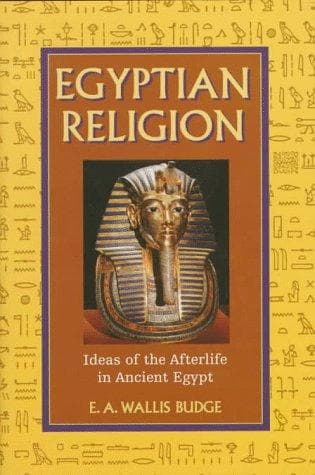
Egyptian Ideas of the Future LifeBudge, E. A. Wallis (Ernest Alfred Wallis), Sir
ReligionComparative
Egyptian Ideas of the Future Life
Budge, E. A. Wallis (Ernest Alfred Wallis), Sir
Egypt -- Religion; Eschatology, Egyptian; Future life
Whether monotheism or polytheism be the older, it is
useless in our present state of knowledge to attempt to enquire.
According to Tiele, the religion of Egypt was at the beginning
polytheistic, but developed in two opposite directions: in the one
direction gods were multiplied by the addition of local gods, and in the
other the Egyptians drew nearer and nearer to monotheism. [Footnote:
_Geschiedenis van den Godedienst in de Oudheid_, Amsterdam, 1893, p. 25.
A number of valuable remarks on this subject are given by Lieblein in
_Egyptian Religion_, p. 10.] Dr. Wiedemann takes the view that three
main elements may be recognized in the Egyptian religion: (1) A solar
monotheism, that is to say one god, the creator of the universe, who
manifests his power especially in the sun and its operations; (2) A cult
of the regenerating power of nature, which expresses itself in the
adoration of ithyphallic gods, of fertile goddesses, and of a series of
animals and of various deities of vegetation; (3) A perception of an
anthropomorphic divinity, the life of whom in this world and in the
world beyond this was typical of the ideal life of man [Footnote: _Le
Livre dei Moris_ (Review in _Muséon_, Tom. xiii. 1893).]--this last
divinity being, of course, Osiris. But here again, as Dr. Wiedemann
says, it is an unfortunate fact that all the texts which we possess are,
in respect of the period of the origin of the Egyptian religion,
comparatively late, and therefore in them we find these three elements
mixed together, along with a number of foreign matters, in such a way as
to make it impossible to discover which of them is the oldest. No better
example can be given of the loose way in which different ideas about a
god and God are mingled in the same text than the "Negative Confession"
in the hundred and twenty-fifth chapter of the Book of the Dead. Here,
in the oldest copies of the passages known, the deceased says, "I have
not cursed God" (1. 38), and a few lines after (1. 42) he adds, "I have
not thought scorn of the god living in my city." It seems that here we
have indicated two different layers of belief, and that the older is
represented by the allusion to the "god of the city," in which case it
would go back to the time when the Egyptian lived in a very primitive
fashion. If we assume that God (who is mentioned in line 38) is Osiris,
it does not do away with the fact that he was regarded as a being
entirely different from the "god of the city" and that he was of
sufficient importance to have one line of the "Confession" devoted to
him. The Egyptian saw no incongruity in setting references to the "gods"
side by side with allusions to a god whom we cannot help identifying
with the Supreme Being and the Creator of the world; his ideas and
beliefs have, in consequence, been sadly misrepresented, and by certain
writers he has been made an object of ridicule. What, for example, could
be a more foolish description of Egyptian worship than the following?
Public-domain text, read in full here on John Shaqi.
Reviews
Reviews
No reviews yet
Be the first to share your thoughts on this work.
Join the Discussion
Join the discussion
Sign in to leave a comment or review.
Sign InorCreate an account