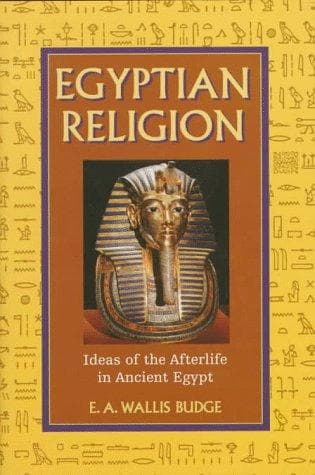
Egyptian Ideas of the Future LifeBudge, E. A. Wallis (Ernest Alfred Wallis), Sir
ReligionComparative
Egyptian Ideas of the Future Life
Budge, E. A. Wallis (Ernest Alfred Wallis), Sir
Egypt -- Religion; Eschatology, Egyptian; Future life
"Who knows not, O Volusius of Bithynia, the sort of monsters Egypt, in
her infatuation, worships. One part venerates the crocodile; another
trembles before an ibis gorged with serpents. The image of a sacred
monkey glitters in gold, where the magic chords sound from Memnon broken
in half, and ancient Thebes lies buried in ruins, with her hundred
gates. In one place they venerate sea-fish, in another river-fish;
there, whole towns worship a dog: no one Diana. It is an impious act to
violate or break with the teeth a leek or an onion. O holy nations!
whose gods grow for them in their gardens! Every table abstains from
animals that have wool: it is a crime there to kill a kid. But human
flesh is lawful food."
[Footnote: Juvenal, Satire XV. (Evans' translation in Bohn's Series, p.
180). Led astray by Juvenal, our own good George Herbert (_Church
Militant_) wrote:--
"At first he (_i.e._, Sin) got to Egypt, and did sow
Gardens of gods, which every year did grow
Fresh and fine deities. They were at great cost,
Who for a god clearly a sallet lost.
Ah, what a thing is man devoid of grace,
Adoring garlic with an humble face,
Begging his food of that which he may eat,
Starving the while he worshippeth his meat!
Who makes a root his god, how low is he,
If God and man be severed infinitely!
What wretchedness can give him any room,
Whose house is foul, while he adores his broom?"]
The epithets which the Egyptians applied to their gods also bear
valuable testimony concerning the ideas which they held about God. We
have already said that the "gods" are only forms, manifestations, and
phases of R[=a], the Sun-god, who was himself the type and symbol of
God, and it is evident from the nature of these epithets that they were
only applied to the "gods" because they represented some qualify or
attribute which they would have applied to God had it been their custom
to address Him. Let us take as examples the epithets which are applied
to H[=a]pi the god of the Nile. The beautiful hymn [Footnote: The whole
hymn has been published by Maspero in _Hymns au Nil_, Paris, 1868.] to
this god opens as follows:--
Public-domain text, read in full here on John Shaqi.
Reviews
Reviews
No reviews yet
Be the first to share your thoughts on this work.
Join the Discussion
Join the discussion
Sign in to leave a comment or review.
Sign InorCreate an account