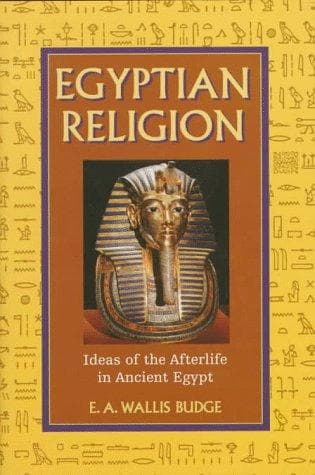
Egyptian Ideas of the Future LifeBudge, E. A. Wallis (Ernest Alfred Wallis), Sir
ReligionComparative
Egyptian Ideas of the Future Life
Budge, E. A. Wallis (Ernest Alfred Wallis), Sir
Egypt -- Religion; Eschatology, Egyptian; Future life
What form the details of the history of Osiris took in the early
dynasties it is impossible to say, and we know not whether Osiris was
the god of the resurrection to the predynastic or prehistoric Egyptians,
or whether that _rôle_ was attributed to him after Mena began to rule in
Egypt. There is, however, good reason for assuming that in the earliest
dynastic times he occupied the position of god and judge of those who
had risen from the dead by his help, for already in the IVth dynasty,
about B.C. 3800, king Mea-kau-R[=a] (the Mycerinus of the Greeks) is
identified with him, and on his coffin not only is he called "Osiris,
King of the South and North, Men-kau-R[=a], living for ever," but the
genealogy of Osiris is attributed to him, and he is declared to be "born
of heaven, offspring of Nut, flesh and bone of Seb." It is evident that
the priests of Heliopolis "edited" the religious texts copied and
multiplied in the College to suit their own views, but in the early
times when they began their work, the worship of Osiris was so
widespread, and the belief in him as the god of the resurrection so
deeply ingrained in the hearts of the Egyptians, that even in the
Heliopolitan system of theology Osiris and his cycle, or company of
gods, were made to hold a very prominent position. He represented to men
the idea of a man who was both god and man, and he typified to the
Egyptians in all ages the being who by reason of his sufferings and
death as a man could sympathize with them in their own sickness and
death. The idea of his human personality also satisfied their cravings
and yearnings for intercourse with a being who, though he was partly
divine, yet had much in common with themselves. Originally they looked
upon Osiris as a man who lived on the earth as they lived, who ate and
drank, who suffered a cruel death, who by the help of certain gods
triumphed over death, and attained unto everlasting life. But what
Osiris did they could do, and what the gods did for Osiris they must
also do for them, and as the gods brought about his resurrection so they
must bring about theirs, and as they made him the ruler of the
underworld so they must make them to enter his kingdom and to live there
as long as the god himself lived. Osiris, in some of his aspects, was
identified with the Nile, and with R[=a], and with several other "gods"
known to the Egyptians, but it was in his aspect as god of the
resurrection and of eternal life that he appealed to men in the valley
of the Nile; and for thousands of years men and women died believing
that, inasmuch as all that was done for Osiris would be done for them
symbolically, they like him would rise again, and inherit life
everlasting. However far back we trace religious ideas in Egypt, we
never approach a time when it can be said that there did not exist a
belief in the Resurrection, for everywhere it is assumed that Osiris
rose from the dead; sceptics must have existed, and they probably asked
Public-domain text, read in full here on John Shaqi.
Reviews
Reviews
No reviews yet
Be the first to share your thoughts on this work.
Join the Discussion
Join the discussion
Sign in to leave a comment or review.
Sign InorCreate an account