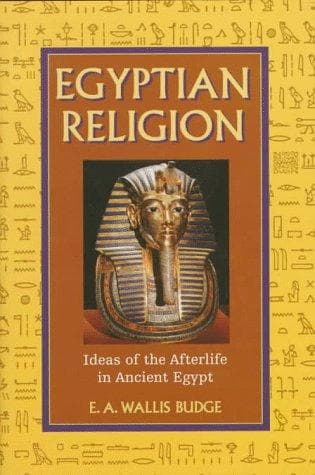
Egyptian Ideas of the Future LifeBudge, E. A. Wallis (Ernest Alfred Wallis), Sir
ReligionComparative
Egyptian Ideas of the Future Life
Budge, E. A. Wallis (Ernest Alfred Wallis), Sir
Egypt -- Religion; Eschatology, Egyptian; Future life
Passing now to the consideration of the meaning of the name for God,
_neter_, we find that great diversity of opinion exists among
Egyptologists on the subject. Some, taking the view that the equivalent
of the word exists in Coptic, under the form of _Nuti_, and because
Coptic is an ancient Egyptian dialect, have sought to deduce its meaning
by seeking in that language for the root from which the word may be
derived. But all such attempts have had no good result, because the word
_Nuti_ stands by itself, and instead of being derived from a Coptic root
is itself the equivalent of the Egyptian _neter_, [Footnote: The letter
_r_ has dropped out in Coptic through phonetic decay.] and was taken
over by the translators of the Holy Scriptures from that language to
express the words "God" and "Lord." The Coptic root _nomti_ cannot in
any way be connected with _nuti_, and the attempt to prove that the two
are related was only made with the view of helping to explain the
fundamentals of the Egyptian religion by means of Sanskrit and other
Aryan analogies. It is quite possible that the word _neter_ means
"strength," "power," and the like, but these are only some of its
derived meanings, and we have to look in the hieroglyphic inscriptions
for help in order to determine its most probable meaning. The eminent
French Egyptologist, E. de Rougé, connected the name of God, _neter_,
with the other word _neter_, "renewal" or "renovation," and it would,
according to his view, seem as if the fundamental idea of God was that
of the Being who had the power to renew himself perpetually--or in other
words, "self-existence." The late Dr. H. Brugsch partly accepted this
view, for he defined _neter_ as being "the active power which produces
and creates things in regular recurrence; which bestows new life upon
them, and gives back to them their youthful vigour." [Footnote:
_Religion und Mythologie_, p. 93.] There seems to be no doubt that,
inasmuch as it is impossible to find any one word which will render
_neter_ adequately and satisfactorily, "self-existence" and "possessing
the power to renew life indefinitely," may together be taken as the
equivalent of _neter_ in our own tongue, M. Maspero combats rightly the
attempt to make "strong" the meaning of _neter_ (masc.), or _neterit_
(fem.) in these words: "In the expressions 'a town _neterit_ 'an arm
_neteri_,' ... is it certain that 'a strong city,' 'a strong arm,' give
us the primitive sense of _neter_? When among ourselves one says 'divine
music,' 'a piece of divine poetry,' 'the divine taste of a peach,' 'the
divine beauty of a woman,' [the word] divine is a hyperbole, but it
would be a mistake to declare that it originally meant 'exquisite'
because in the phrases which I have imagined one could apply it as
'exquisite music,' 'a piece of exquisite poetry,' 'the exquisite taste
of a peach,' 'the exquisite beauty of a woman.' Similarly, in Egyptian,
'a town _neterit_ is 'a divine town;' 'an arm _netsri_' is 'a divine
Public-domain text, read in full here on John Shaqi.
Reviews
Reviews
No reviews yet
Be the first to share your thoughts on this work.
Join the Discussion
Join the discussion
Sign in to leave a comment or review.
Sign InorCreate an account