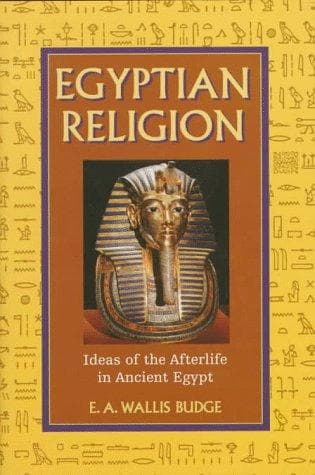
Egyptian Ideas of the Future LifeBudge, E. A. Wallis (Ernest Alfred Wallis), Sir
ReligionComparative
Egyptian Ideas of the Future Life
Budge, E. A. Wallis (Ernest Alfred Wallis), Sir
Egypt -- Religion; Eschatology, Egyptian; Future life
arm,' and _neteri_ is employed metaphorically in Egyptian as is [the
word] 'divine' in French, without its being any more necessary to
attribute to [the word] _neteri_ the primitive meaning of 'strong,' than
it is to attribute to [the word] 'divine' the primitive meaning of
'exquisite.'" [Footnote: _La Mythologie Egyptienne_, p. 215.] It may be,
of course, that _neter_ had another meaning which is now lost, but it
seems that the great difference between God and his messengers and
created things is that he is the Being who is self-existent and
immortal, whilst they are not self-existent and are mortal.
Here it will be objected by those who declare that the ancient Egyptian
idea of God is on a level with that evolved by peoples and tribes who
stand comparatively little removed from very intelligent animals, that
such high conceptions as self-existence and immortality belong to a
people who are already on a high grade of development and civilization.
This is precisely the case with the Egyptians when we first know them.
As a matter of fact, we know nothing of their ideas of God before they
developed sufficiently to build the monuments which we know they built,
and before they possessed the religion, and civilization, and complex
social system which their writings have revealed to us. In the remotest
prehistoric times it is probable that their views about God and the
future life were little better than those of the savage tribes, now
living, with whom some have compared them. The primitive god was an
essential feature of the family, and the fortunes of the god varied with
the fortunes of the family; the god of the city in which a man lived was
regarded as the ruler of the city, and the people of that city no more
thought of neglecting to provide him with what they considered to be due
to his rank and position than they thought of neglecting to supply their
own wants. In fact the god of the city became the centre of the social
fabric of that city, and every inhabitant thereof inherited
automatically certain duties, the neglect of which brought stated pains
and penalties upon him. The remarkable peculiarity of the Egyptian
religion is that the primitive idea of the god of the city is always
cropping up in it, and that is the reason why we find semi-savage ideas
of God side by side with some of the most sublime conceptions, and it of
course underlies all the legends of the gods wherein they possess all
the attributes of men and women. The Egyptian in his semi-savage state
was neither better nor worse than any other man in the same stage of
civilization, but he stands easily first among the nations in his
capacity for development, and in his ability for evolving conceptions
concerning God and the future life, which are claimed as the peculiar
product of the cultured nations of our time.
Public-domain text, read in full here on John Shaqi.
Reviews
Reviews
No reviews yet
Be the first to share your thoughts on this work.
Join the Discussion
Join the discussion
Sign in to leave a comment or review.
Sign InorCreate an account