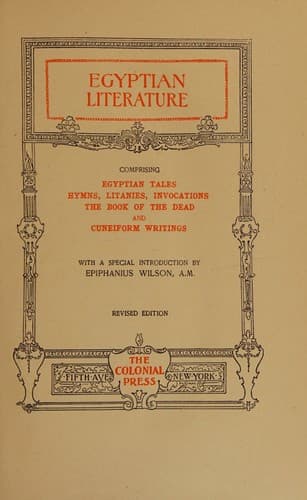
Egyptian Literature: Comprising Egyptian tales, hymns, litanies, invocations, the Book of the Dead, and cuneiform writings
Religion
Egyptian Literature: Comprising Egyptian tales, hymns, litanies, invocations, the Book of the Dead, and cuneiform writings
Egyptian literature -- Translations into English
12 B. M.—“_Ribadda_ speaks to the King of Lands, of many lands, the great
King the prosperous King. The Lady (Ballath) of Gebal gives power to the
King my Lord. I bow at my Lord’s feet—the Sun-God—seven times seven times.
Let the King know! behold! the city _Gebal_ his handmaid, faithful to the
King, has gathered because of the allies who are his foes. And I am ill at
ease: behold the King lets slip from his hand the chief city that is
faithful to him. Let the King smite the lands of those who rob him. Lo! is
not he a faithful servant, her chief who abides in the city of _Gebal_? Do
not you say so to your servant, when there is a mighty fighting against
him of men of blood, and the Gods of the land are (evilly disposed?), and
our sons have been worn out, and our daughters have fled, and there is
weakness in my unhappy land. For our living, my fields gave sustenance,
which no ... secured. For as many as I possess, all my cities which are in
flames, also the foe has overthrown: they submitted to the bloody
soldiers. The city of _Gebal_ with two cities, remains to me; and I am ill
at ease because _Abdasherah_ is marching. The city of _Sigata_ (is) his;
and he is saying to the chiefs of the city of _Ammia_ (_Amyun_), ‘They
have slain your chief and you have done like us, and you have rebelled,
and you obeyed his order, and they will punish you as men of blood.’ And I
am ill at ease. Lo! now _Abdasherah_ sends for soldiers. I have remained
alone—they will be rejoiced at it, and there is ruin before the city of
_Gebal_, if there is no great man to gain me safety from his hands. And
the chiefs of the government are expelled from the midst of the lands; and
you relinquish all the lands to the men of blood, squandering the wealth
of all the lands; and they have torn away sons and daughters nobly born;
and (this) while the King is pondering about it, and all the lands have
fought for him. And from what they have done to us, behold now thou wilt
become naked to their destructions. And so now I am exceedingly afraid.
Behold now there is no great man who wins me salvation from their hands.
As birds that are in the midst of the snares this place has remained. I
myself am in the city of _Gebal_. Why is there this overthrow of thy land?
Now I send (complaint?) to the palace (or great city) and you will not
hear us. Now this (is) my message. _Amanabba_ is with thee, ask him: he
has fled,(277) and he will show the evils that are against me. Let the
King hear his servant’s message; and he shall establish his servant’s
life, and his servant shall live, and shall defend the ... with him.”
The remainder of the letter is broken. It asks for advice and information,
and for consideration of the memorial. Ribadda’s letters increase in
pathetic eloquence as the great catastrophe approaches.
56 B., a much-broken letter. They are advancing to take _Gebal_. Money has
been given to a certain chief who has turned against _Ribadda_.
Public-domain text, read in full here on John Shaqi.
Reviews
Reviews
No reviews yet
Be the first to share your thoughts on this work.
Elsewhere in the archive
Join the Discussion
Join the discussion
Sign in to leave a comment or review.
Sign InorCreate an account