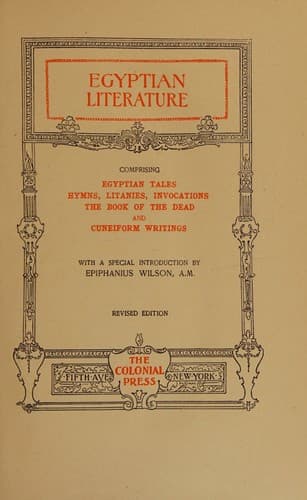
Egyptian Literature: Comprising Egyptian tales, hymns, litanies, invocations, the Book of the Dead, and cuneiform writings
Religion
Egyptian Literature: Comprising Egyptian tales, hymns, litanies, invocations, the Book of the Dead, and cuneiform writings
Egyptian literature -- Translations into English
The wonders of Egyptian archæology are the latest and most precious
harvest of scholars and explorers. From Belzoni to Flinders Petrie there
has been a succession of discoveries in the valley of the Nile with which
it is hard for ordinary students to keep pace. Our knowledge of Egyptian
life to-day is far clearer and more complete than Bentley’s or Porson’s
acquaintance with the antiquities of Greece and Rome, and we have far more
complete access to the treasures of Egyptian literature than Dante or
Thomas Aquinas had to the remains of Attic poets and mystics. We know
exactly how an Egyptian of the twelfth dynasty dressed; what was the
position of women in Egypt; and what uniform was worn by the Egyptian
soldiers who took part in the campaign against Khitasis. We can see
Rameses II riding in his war-chariot; we know the very names of the horses
by whose side his tame lion is running and thirsting for the blood of his
master’s foes. We know all about the domestic animals, the funeral
customs, the trades, the gods, the agriculture of the Nile valley thirty
centuries ago. We see the whole many-sided civilization portrayed in the
brightest colors in the poetry, the books of ritual, the hieratic
inscriptions, the tablets, papyri, and hieroglyphics which day by day come
to light in exhaustless abundance from the mounds and ruins of that
fertile plain that stretches from Thebes to the Mareotic lake.
For instance, we can learn exact particulars about the mode in which
Rameses II made war, from the poem of Penta-Our, a Theban writer of the
fourteenth century B.C. It is only by a figure of speech that this poem
can be called an epic; it is rather a historical narrative couched in
terms of poetic exaggeration with the object of flattering the royal
vanity of Pharaoh.
The campaign in which Rameses then engaged was directed against Kadesh, a
city built on an island in the Orontes. It is, according to Penta-Our,
inhabited by a people known as Khita, whose spies are brought into the
tent of Rameses and questioned as to the whereabouts of the King of
Kadesh. The spies are forced by blows to answer, and they tell the
Egyptian monarch that the King of the Khita “is powerful with many
soldiers, and with chariot soldiers, and with their harness, as many as
the sand of the seashore, and they are ready to fight behind Kadesh.”
Public-domain text, read in full here on John Shaqi.
Reviews
Reviews
No reviews yet
Be the first to share your thoughts on this work.
Join the Discussion
Join the discussion
Sign in to leave a comment or review.
Sign InorCreate an account