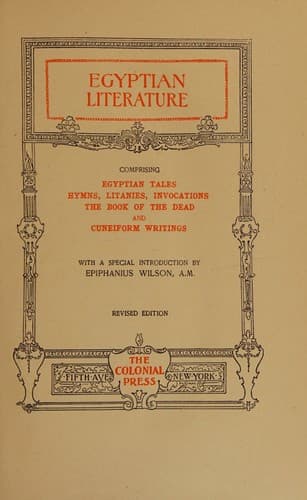
Egyptian Literature: Comprising Egyptian tales, hymns, litanies, invocations, the Book of the Dead, and cuneiform writings
Religion
Egyptian Literature: Comprising Egyptian tales, hymns, litanies, invocations, the Book of the Dead, and cuneiform writings
Egyptian literature -- Translations into English
The King is very angry; for he had been deceived by false news to the
effect that his enemy had fled in terror to Khilibu. “The fault is great,”
he cries, “that the governors of the land and the vassal princes of
Pharaoh have committed, in neglecting to watch the movements of the
Khita.” He sends to bring back the legions he had sent away, and meanwhile
the approach of the enemy is announced. The camp of Rameses is surprised
by the Asiatics; many foot-soldiers are killed before they can seize their
weapons, but a faithful band rallies in front of the royal quarters.
Suddenly a cry is heard; Rameses has quickly put on his armor, seized his
lance, ordered his war lion to be loosed, and dashed into the fight.
Pharaoh with his master of the horse, Menni, is soon hemmed in by foes.
“My Lord, O generous King!” cries Menni, “Egypt’s great protector in the
day of battle! behold we stand alone in the midst of the enemy, for the
archers and the chariots have left us. Let us return, that our lives may
be saved. Save us, O my Lord, Rameses Miamun!” Then Rameses called upon
Amen, his god, and under his protection charged the enemy, and “his hand
devoured them in the space of an instant.” Five times he rushed upon them,
and five times they repulsed him. The sixth time he breaks their ranks and
regains his own lines. Then the legions of Ptah, which had returned to the
camp, join the battle, and the Asiatics are routed. The first care of
Rameses is to refresh his brave horses, Victory-in-Thebes and
Maut-is-Satisfied. Neither they nor Rameses and his lion are wounded,
though all stained with blood and dust, while the head-plumes of the team
are torn and tattered and their caparison broken.
This is a brief account of the main incident in this Egyptian epic, which
is written with life-like detail and animation. The war concludes with a
treaty, and the marriage of Rameses with the daughter of the King of
Kadesh, so that henceforth “the people of Egypt were of one mind with the
princes of Khita, which had not been the case since the god Rā.”
The Egyptians have always been deeply impressed by the fact of human
mortality, and much of their religious belief and religious ritual is
taken up with the rites of burial, and detailed doctrines as to the
experience of the soul after parting from the body. Their elaborate
embalming of the dead springs from the desire to keep the mortal tenement
prepared for the soul’s return to it. In their Book of the Dead is a full
series of prayers, songs, and incantations to be employed at funerals, and
by the individual in his journey beyond the tomb. The funeral procession
was a very noisy company; lamentations were heard through its whole
length, but the burden of the hymns was always, “To the West.” This was
enlarged upon, “To the West, the dwelling of Osiris; O Chief, as thou
goest to the West, the Gods themselves lament, as thou goest to the West.”
Public-domain text, read in full here on John Shaqi.
Reviews
Reviews
No reviews yet
Be the first to share your thoughts on this work.
Join the Discussion
Join the discussion
Sign in to leave a comment or review.
Sign InorCreate an account