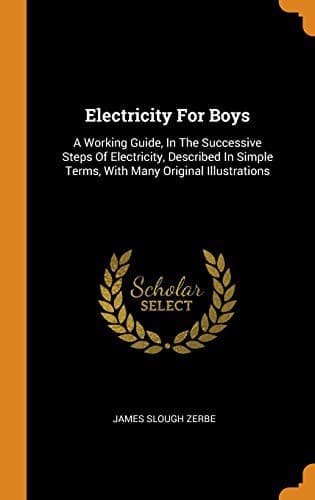
Electric apparatus and appliances; Electrical engineering -- Juvenile literature
Incandescent circuit 167
120. Magnetic action in dynamo, 1st 177
121. Magnetic action in dynamo, 2d 177
122. Magnetic action in dynamo, 3d 178
123. Magnetic action in dynamo, 4th 178
124. Magnetic action in motor, 1st 179
125. Magnetic action in motor, 2d 179
126. Magnetic action in motor, 3d 180
127. Magnetic action in motor, 4th 180
INTRODUCTORY
Electricity, like every science, presents two phases to the student, one
belonging to a theoretical knowledge, and the other which pertains to
the practical application of that knowledge. The boy is directly
interested in the practical use which he can make of this wonderful
phenomenon in nature.
It is, in reality, the most successful avenue by which he may obtain the
theory, for he learns the abstract more readily from concrete examples.
It is an art in which shop practice is a greater educator than can be
possible with books. Boys are not, generally, inclined to speculate or
theorize on phenomena apart from the work itself; but once put them into
contact with the mechanism itself, let them become a living part of it,
and they will commence to reason and think for themselves.
It would be a dry, dull and uninteresting thing to tell a boy that
electricity can be generated by riveting together two pieces of
dissimilar metals, and applying heat to the juncture. But put into his
hands the metals, and set him to perform the actual work of riveting the
metals together, then wiring up the ends of the metals, heating them,
and, with a galvanometer, watching for results, it will at once make him
see something in the experiment which never occurred when the abstract
theory was propounded.
He will inquire first what metals should be used to get the best
results, and finally, he will speculate as to the reasons for the
phenomena. When he learns that all metals are positive-negative or
negative-positive to each other, he has grasped a new idea in the realm
of knowledge, which he unconsciously traces back still further, only to
learn that he has entered a field which relates to the constitution of
matter itself. As he follows the subject through its various channels he
will learn that there is a common source of all things; a manifestation
common to all matter, and that all substances in nature are linked
together in a most wonderful way.
An impulse must be given to a boy's training. The time is past for the
rule-and-rote method. The rule can be learned better by a manual
application than by committing a sentence to memory.
Public-domain text, read in full here on John Shaqi.
Reviews
Reviews
No reviews yet
Be the first to share your thoughts on this work.
Join the Discussion
Join the discussion
Sign in to leave a comment or review.
Sign InorCreate an account