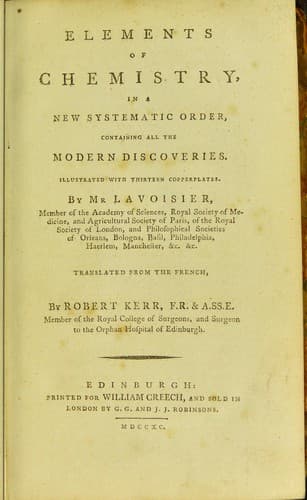
Elements of Chemistry,: In a New Systematic Order, Containing all the Modern DiscoveriesLavoisier, Antoine Laurent
Science
Elements of Chemistry,: In a New Systematic Order, Containing all the Modern Discoveries
Lavoisier, Antoine Laurent
Chemistry -- Early works to 1800
The composition of these four earths is totally unknown, and, until by
new discoveries their constituent elements are ascertained, we are
certainly authorised to consider them as simple bodies. Art has no share
in the production of these earths, as they are all procured ready
formed from nature; but, as they have all, especially the three first,
great tendency to combination, they are never found pure. Lime is
usually saturated with carbonic acid in the state of chalk, calcarious
spars, most of the marbles, &c.; sometimes with sulphuric acid, as in
gypsum and plaster stones; at other times with fluoric acid forming
vitreous or fluor spars; and, lastly, it is found in the waters of the
sea, and of saline springs, combined with muriatic acid. Of all the
salifiable bases it is the most universally spread through nature.
Magnesia is found in mineral waters, for the most part combined with
sulphuric acid; it is likewise abundant in sea-water, united with
muriatic acid; and it exists in a great number of stones of different
kinds.
Barytes is much less common than the three preceding earths; it is found
in the mineral kingdom, combined with sulphuric acid, forming heavy
spars, and sometimes, though rarely, united to carbonic acid.
Argill, or the base of alum, having less tendency to combination than
the other earths, is often found in the state of argill, uncombined with
any acid. It is chiefly procurable from clays, of which, properly
speaking, it is the base, or chief ingredient.
Sec. 5. _Of Metallic Bodies._
The metals, except gold, and sometimes silver, are rarely found in the
mineral kingdom in their metallic state, being usually less or more
saturated with oxygen, or combined with sulphur, arsenic, sulphuric
acid, muriatic acid, carbonic acid, or phosphoric acid. Metallurgy, or
the docimastic art, teaches the means of separating them from these
foreign matters; and for this purpose we refer to such chemical books as
treat upon these operations.
We are probably only acquainted as yet with a part of the metallic
substances existing in nature, as all those which have a stronger
affinity to oxygen, than charcoal possesses, are incapable of being
reduced to the metallic state, and, consequently, being only presented
to our observation under the form of oxyds, are confounded with earths.
It is extremely probable that barytes, which we have just now arranged
with earths, is in this situation; for in many experiments it exhibits
properties nearly approaching to those of metallic bodies. It is even
possible that all the substances we call earths may be only metallic
oxyds, irreducible by any hitherto known process.
Those metallic bodies we are at present acquainted with, and which we
can reduce to the metallic or reguline state, are the following
seventeen:
Public-domain text, read in full here on John Shaqi.
Reviews
Reviews
No reviews yet
Be the first to share your thoughts on this work.
Elsewhere in the archive
Join the Discussion
Join the discussion
Sign in to leave a comment or review.
Sign InorCreate an account