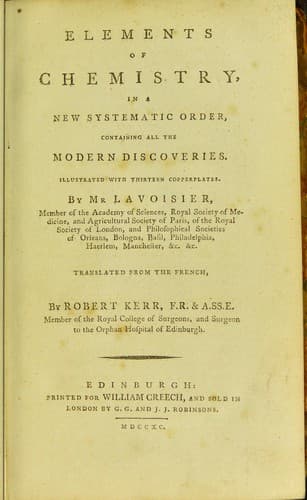
Elements of Chemistry,: In a New Systematic Order, Containing all the Modern DiscoveriesLavoisier, Antoine Laurent
Science
Elements of Chemistry,: In a New Systematic Order, Containing all the Modern Discoveries
Lavoisier, Antoine Laurent
Chemistry -- Early works to 1800
1. Arsenic.
2. Molybdena.
3. Tungstein.
4. Manganese.
5. Nickel.
6. Cobalt.
7. Bismuth.
8. Antimony.
9. Zinc.
10. Iron.
11. Tin.
12. Lead.
13. Copper.
14. Mercury.
15. Silver.
16. Platina.
17. Gold.
I only mean to consider these as salifiable bases, without entering at
all upon the consideration of their properties in the arts, and for the
uses of society. In these points of view each metal would require a
complete treatise, which would lead me far beyond the bounds I have
prescribed for this work.
FOOTNOTES:
[30] I have not ventured to omit this element, as here enumerated with
the other principles of animal and vegetable substances, though it is
not at all taken notice of in the preceding chapters as entering into
the composition of these bodies.--E.
[31] Perhaps my thus rejecting the alkalies from the class of salts may
be considered as a capital defect in the method I have adopted, and I am
ready to admit the charge; but this inconvenience is compensated by so
many advantages, that I could not think it of sufficient consequence to
make me alter my plan.--A.
[32] Called Alumine by Mr Lavoisier; but as Argill has been in a manner
naturalized to the language for this substance by Mr Kirwan, I have
ventured to use it in preference.--E.
CHAP. XVII.
_Continuation of the Observations upon Salifiable Bases, and the
Formation of Neutral Salts._
It is necessary to remark, that earths and alkalies unite with acids to
form neutral salts without the intervention of any medium, whereas
metallic substances are incapable of forming this combination without
being previously less or more oxygenated; strictly speaking, therefore,
metals are not soluble in acids, but only metallic oxyds. Hence, when we
put a metal into an acid for solution, it is necessary, in the first
place, that it become oxygenated, either by attracting oxygen from the
acid or from the water; or, in other words, that a metal cannot be
dissolved in an acid unless the oxygen, either of the acid, or of the
water mixed with it, has a stronger affinity to the metal than to the
hydrogen or the acidifiable base; or, what amounts to the same thing,
that no metallic solution can take place without a previous
decomposition of the water, or the acid in which it is made. The
explanation of the principal phenomena of metallic solution depends
entirely upon this simple observation, which was overlooked even by the
illustrious Bergman.
Public-domain text, read in full here on John Shaqi.
Reviews
Reviews
No reviews yet
Be the first to share your thoughts on this work.
Elsewhere in the archive
Join the Discussion
Join the discussion
Sign in to leave a comment or review.
Sign InorCreate an account