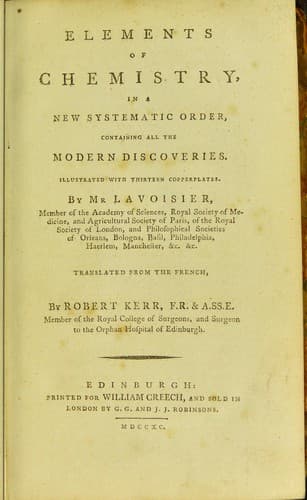
Elements of Chemistry,: In a New Systematic Order, Containing all the Modern DiscoveriesLavoisier, Antoine Laurent
Science
Elements of Chemistry,: In a New Systematic Order, Containing all the Modern Discoveries
Lavoisier, Antoine Laurent
Chemistry -- Early works to 1800
These distinctions are not, as some may imagine, merely metaphysical,
but are established by Nature. "A child," says the Abbe de Condillac,
"is taught to give the name _tree_ to the first one which is pointed out
to him. The next one he sees presents the same idea, and he gives it the
same name. This he does likewise to a third and a fourth, till at last
the word _tree_, which he first applied to an individual, comes to be
employed by him as the name of a class or a genus, an abstract idea,
which comprehends all trees in general. But, when he learns that all
trees serve not the same purpose, that they do not all produce the same
kind of fruit, he will soon learn to distinguish them by specific and
particular names." This is the logic of all the sciences, and is
naturally applied to chemistry.
The acids, for example, are compounded of two substances, of the order
of those which we consider as simple; the one constitutes acidity, and
is common to all acids, and, from this substance, the name of the class
or the genus ought to be taken; the other is peculiar to each acid, and
distinguishes it from the rest, and from this substance is to be taken
the name of the species. But, in the greatest number of acids, the two
constituent elements, the acidifying principle, and that which it
acidifies, may exist in different proportions, constituting all the
possible points of equilibrium or of saturation. This is the case in the
sulphuric and the sulphurous acids; and these two states of the same
acid we have marked by varying the termination of the specific name.
Metallic substances which have been exposed to the joint action of the
air and of fire, lose their metallic lustre, increase in weight, and
assume an earthy appearance. In this state, like the acids, they are
compounded of a principle which is common to all, and one which is
peculiar to each. In the same way, therefore, we have thought proper to
class them under a generic name, derived from the common principle; for
which purpose, we adopted the term _oxyd_; and we distinguish them from
each other by the particular name of the metal to which each belongs.
Public-domain text, read in full here on John Shaqi.
Elements of Chemistry,: In a New Systematic Order, Containing all the Modern Discoveries — John Shaqi
Reviews
Reviews
No reviews yet
Be the first to share your thoughts on this work.
Join the Discussion
Join the discussion
Sign in to leave a comment or review.
Sign InorCreate an account