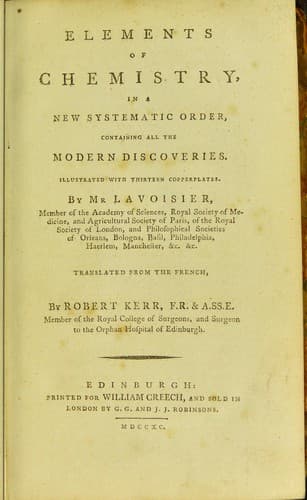
Elements of Chemistry,: In a New Systematic Order, Containing all the Modern DiscoveriesLavoisier, Antoine Laurent
Science
Elements of Chemistry,: In a New Systematic Order, Containing all the Modern Discoveries
Lavoisier, Antoine Laurent
Chemistry -- Early works to 1800
Combustible substances, which in acids and metallic oxyds are a specific
and particular principle, are capable of becoming, in their turn, common
principles of a great number of substances. The sulphurous combinations
have been long the only known ones in this kind. Now, however, we know,
from the experiments of Messrs Vandermonde, Monge, and Berthollet, that
charcoal may be combined with iron, and perhaps with several other
metals; and that, from this combination, according to the proportions,
may be produced steel, plumbago, &c. We know likewise, from the
experiments of M. Pelletier, that phosphorus may be combined with a
great number of metallic substances. These different combinations we
have classed under generic names taken from the common substance, with a
termination which marks this analogy, specifying them by another name
taken from that substance which is proper to each.
The nomenclature of bodies compounded of three simple substances was
attended with still greater difficulty, not only on account of their
number, but, particularly, because we cannot express the nature of their
constituent principles without employing more compound names. In the
bodies which form this class, such as the neutral salts, for instance,
we had to consider, 1st, The acidifying principle, which is common to
them all; 2d, The acidifiable principle which constitutes their peculiar
acid; 3d, The saline, earthy, or metallic basis, which determines the
particular species of salt. Here we derived the name of each class of
salts from the name of the acidifiable principle common to all the
individuals of that class; and distinguished each species by the name of
the saline, earthy, or metallic basis, which is peculiar to it.
A salt, though compounded of the same three principles, may,
nevertheless, by the mere difference of their proportion, be in three
different states. The nomenclature we have adopted would have been
defective, had it not expressed these different states; and this we
attained chiefly by changes of termination uniformly applied to the same
state of the different salts.
In short, we have advanced so far, that from the name alone may be
instantly found what the combustible substance is which enters into any
combination; whether that combustible substance be combined with the
acidifying principle, and in what proportion; what is the state of the
acid; with what basis it is united; whether the saturation be exact, or
whether the acid or the basis be in excess.
Public-domain text, read in full here on John Shaqi.
Reviews
Reviews
No reviews yet
Be the first to share your thoughts on this work.
Join the Discussion
Join the discussion
Sign in to leave a comment or review.
Sign InorCreate an account