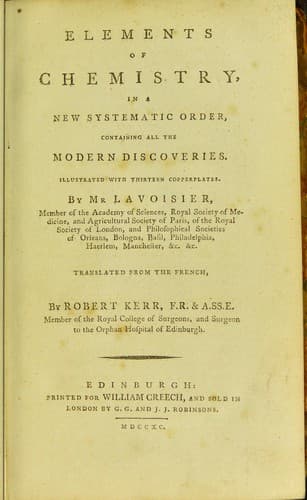
Elements of Chemistry,: In a New Systematic Order, Containing all the Modern DiscoveriesLavoisier, Antoine Laurent
Science
Elements of Chemistry,: In a New Systematic Order, Containing all the Modern Discoveries
Lavoisier, Antoine Laurent
Chemistry -- Early works to 1800
_Note._--All these salts were unknown to the ancients; and even those
chemists who are most versant in modern discoveries, are yet at a lose
whether the greater part of the salts produced by the oxygenated acetic
radical belong properly to the class of acetites, or to that of
acetats.--A.
SECT. XXXIV.--_Observations upon Acetic Acid, and its Combinations._
We have given to radical vinegar the name of acetic acid, from supposing
that it consists of the same radical with that of the acetous acid, but
more highly saturated with oxygen. According to this idea, acetic acid
is the highest degree of oxygenation of which the hydro-carbonous
radical is susceptible; but, although this circumstance be extremely
probable, it requires to be confirmed by farther, and more decisive
experiments, before it be adopted as an absolute chemical truth. We
procure this acid as follows: Upon three parts acetite of potash or of
copper, pour one part of concentrated sulphuric acid, and, by
distillation, a very highly concentrated vinegar is obtained, which we
call acetic acid, formerly named radical vinegar. It is not hitherto
rigorously proved that this acid is more highly oxygenated than the
acetous acid, nor that the difference between them may not consist in a
different proportion between the elements of the radical or base.
TABLE _of the Combinations of Succinic Acid with the Salifiable Bases,
in the order of Affinity._
_Bases._ _Neutral Salts._
Barytes Succinat of barytes.
Lime lime.
Potash potash.
Soda soda.
Ammoniac ammoniac.
Magnesia magnesia.
Argill argill.
Oxyd of zinc zinc.
iron iron.
manganese manganese.
cobalt cobalt.
nickel nickel.
lead lead.
tin tin.
copper copper.
bismuth bismuth.
antimony antimony.
arsenic arsenic.
mercury mercury.
silver silver.
gold gold.
platina platina.
_Note._--All the succinats were unknown to the ancient chemists.--A.
SECT. XXXV.--_Observations upon Succinic Acid, and its Combinations._
The succinic acid is drawn from amber by sublimation in a gentle heat,
and rises in a concrete form into the neck of the subliming vessel. The
operation must not be pushed too far, or by too strong a fire, otherwise
the oil of the amber rises alongst with the acid. The salt is dried upon
blotting paper, and purified by repeated solution and crystallization.
Public-domain text, read in full here on John Shaqi.
Reviews
Reviews
No reviews yet
Be the first to share your thoughts on this work.
Elsewhere in the archive
Join the Discussion
Join the discussion
Sign in to leave a comment or review.
Sign InorCreate an account