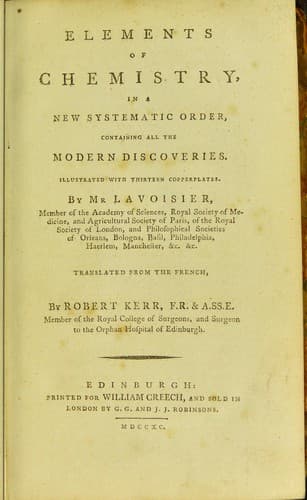
Elements of Chemistry,: In a New Systematic Order, Containing all the Modern DiscoveriesLavoisier, Antoine Laurent
Science
Elements of Chemistry,: In a New Systematic Order, Containing all the Modern Discoveries
Lavoisier, Antoine Laurent
Chemistry -- Early works to 1800
I have not hitherto explained the most important part of the use of this
machine, which is the manner of employing it for ascertaining the
quantities of the air or gas furnished during experiments. To determine
this with the most rigorous precision, and likewise the quantity
supplied to the machine from experiments, we fixed to the arc which
terminates the arm of the beam E, Pl. VIII. Fig. 1. the brass sector l
m, divided into degrees and half degrees, which consequently moves in
common with the beam; and the lowering of this end of the beam is
measured by the fixed index 29, 30, which has a Nonius giving hundredth
parts of a degree at its extremity 30.
The whole particulars of the different parts of the above described
machine are represented in Plate VIII. as follow.
Fig. 2. Is the flat chain invented by Mr Vaucanson, and employed for
suspending the scale or bason P, Fig. 1; but, as this lengthens or
shortens according as it is more or less loaded, it would not have
answered for suspending the jar A, Fig. 1.
Fig. 5. Is the chain i k m, which in Fig. 1. sustains the jar A. This
is entirely formed of plates of polished iron interlaced into each
other, and held together by iron pins. This chain does not lengthen in
any sensible degree, by any weight it is capable of supporting.
Fig. 6. The trivet, or three branched stirrup, by which the jar A is
hung to the balance, with the screw by which it is fixed in an
accurately vertical position.
Fig. 3. The iron rod 26, 27, which is fixed perpendicular to the center
of the beam, with its box 28.
Fig. 7. & 8. The friction-wheels, with the plates of rock-cristal Z, as
points of contact by which the friction of the axis of the lever of the
balance is avoided.
Fig. 4. The piece of metal which supports the axis of the
friction-wheels.
Fig. 9. The middle of the lever or beam, with the axis upon which it
moves.
Fig. 10. The thermometer for determining the temperature of the air or
gas contained in the jar.
When this gazometer is to be used, the cistern or external vessel, LMNO,
Pl. VIII. Fig. 1. is to be filled with water to a determinate height,
which should be the same in all experiments. The level of the water
should be taken when the beam of the balance stands horizontal; this
level, when the jar is at the bottom of the cistern, is increased by all
the water which it displaces, and is diminished in proportion as the jar
rises to its highest elevation. We next endeavour, by repeated trials,
to discover at what elevation the box 28 must be fixed, to render the
pressure equal in all situations of the beam. I should have said nearly,
because this correction is not absolutely rigorous; and differences of a
quarter, or even of half a line, are not of any consequence. This height
of the box 28 is not the same for every degree of pressure, but varies
according as this is of one, two, three, or more inches. All these
should be registered with great order and precision.
Public-domain text, read in full here on John Shaqi.
Reviews
Reviews
No reviews yet
Be the first to share your thoughts on this work.
Elsewhere in the archive
Join the Discussion
Join the discussion
Sign in to leave a comment or review.
Sign InorCreate an account