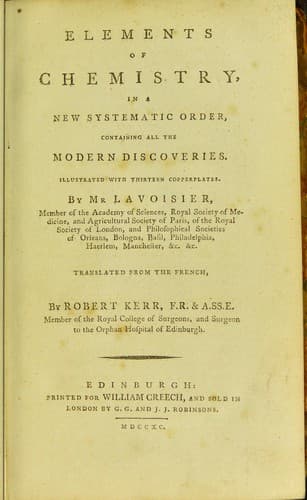
Elements of Chemistry,: In a New Systematic Order, Containing all the Modern DiscoveriesLavoisier, Antoine Laurent
Science
Elements of Chemistry,: In a New Systematic Order, Containing all the Modern Discoveries
Lavoisier, Antoine Laurent
Chemistry -- Early works to 1800
We next take a bottle which holds eight or ten pints, the capacity of
which is very accurately determined by weighing the water it is capable
of containing. This bottle is turned bottom upwards, full of water, in
the cistern of the pneumato chemical apparatus GHIK, Fig. 1. and is set
on its mouth upon the shelf of the apparatus, instead of the glass jar
V, having the extremity 11 of the tube 7, 8, 9, 10, 11, inserted into
its mouth. The machine is fixed at zero of pressure, and the degree
marked by the index 30 upon the sector m l is accurately observed;
then, by opening the stop-cock 8, and pressing a little upon the jar A,
as much air is forced into the bottle as fills it entirely. The degree
marked by the index upon the sector is now observed, and we calculate
what number of cubical inches correspond to each degree. We then fill a
second and third bottle, and so on, in the same manner, with the same
precautions, and even repeat the operation several times with bottles of
different sizes, till at last, by accurate attention, we ascertain the
exact gage or capacity of the jar A, in all its parts; but it is better
to have it formed at first accurately cylindrical, by which we avoid
these calculations and estimates.
The instrument I have been describing was constructed with great
accuracy and uncommon skill by Mr Meignie junior, engineer and physical
instrument-maker. It is a most valuable instrument, from the great
number of purposes to which it is applicable; and, indeed, there are
many experiments which are almost impossible to be performed without it.
It becomes expensive, because, in many experiments, such as the
formation of water and of nitric acid, it is absolutely necessary to
employ two of the same machines. In the present advanced state of
chemistry, very expensive and complicated instruments are become
indispensibly necessary for ascertaining the analysis and synthesis of
bodies with the requisite precision as to quantity and proportion; it is
certainly proper to endeavour to simplify these, and to render them less
costly; but this ought by no means to be attempted at the expence of
their conveniency of application, and much less of their accuracy.
SECT. III.
_Some other methods of measuring the volume of Gasses._
The gazometer described in the foregoing section is too costly and too
complicated for being generally used in laboratories for measuring the
gasses, and is not even applicable to every circumstance of this kind.
In numerous series of experiments, more simple and more readily
applicable methods must be employed. For this purpose I shall describe
the means I used before I was in possession of a gazometer, and which I
still use in preference to it in the ordinary course of my experiments.
Public-domain text, read in full here on John Shaqi.
Reviews
Reviews
No reviews yet
Be the first to share your thoughts on this work.
Elsewhere in the archive
Join the Discussion
Join the discussion
Sign in to leave a comment or review.
Sign InorCreate an account