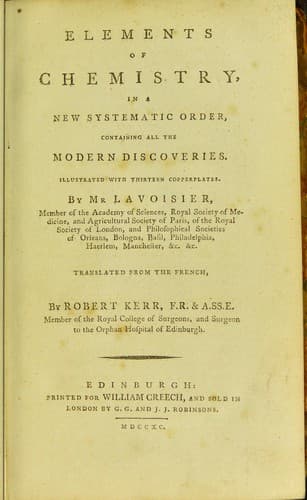
Elements of Chemistry,: In a New Systematic Order, Containing all the Modern DiscoveriesLavoisier, Antoine Laurent
Science
Elements of Chemistry,: In a New Systematic Order, Containing all the Modern Discoveries
Lavoisier, Antoine Laurent
Chemistry -- Early works to 1800
Suppose that, after an experiment, there is a residuum of gas, neither
absorbable by alkali nor water, contained in the upper part of the jar
AEF, Pl. IV. Fig. 3. standing on the shelf of a pneumato-chemical
apparatus, of which we wish to ascertain the quantity, we must first
mark the height to which the mercury or water rises in the jar with
great exactness, by means of slips of paper pasted in several parts
round the jar. If we have been operating in mercury, we begin by
displacing the mercury from the jar, by introducing water in its stead.
This is readily done by filling a bottle quite full of water; having
stopped it with your finger, turn it up, and introduce its mouth below
the edge of the jar; then, turning down its body again, the mercury, by
its gravity, falls into the bottle, and the water rises in the jar, and
takes the place occupied by the mercury. When this is accomplished, pour
so much water into the cistern ABCD as will stand about an inch over the
surface of the mercury; then pass the dish BC, Pl. V. Fig. 9. under the
jar, and carry it to the water cistern, Fig. 1. and 2. We here exchange
the gas into another jar, which has been previously graduated in the
manner to be afterwards described; and we thus judge of the quantity or
volume of the gas by means of the degrees which it occupies in the
graduated jar.
There is another method of determining the volume of gas, which may
either be substituted in place of the one above described, or may be
usefully employed as a correction or proof of that method. After the air
or gas is exchanged from the first jar, marked with slips of paper, into
the graduated jar, turn up the mouth of the marked jar, and fill it with
water exactly to the marks EF, Pl. IV. Fig. 3. and by weighing the water
we determine the volume of the air or gas it contained, allowing one
cubical foot, or 1728 cubical inches, of water for each 70 pounds,
French weight.
Public-domain text, read in full here on John Shaqi.
Reviews
Reviews
No reviews yet
Be the first to share your thoughts on this work.
Elsewhere in the archive
Join the Discussion
Join the discussion
Sign in to leave a comment or review.
Sign InorCreate an account