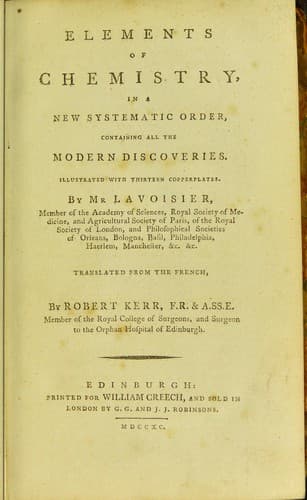
Elements of Chemistry,: In a New Systematic Order, Containing all the Modern DiscoveriesLavoisier, Antoine Laurent
Science
Elements of Chemistry,: In a New Systematic Order, Containing all the Modern Discoveries
Lavoisier, Antoine Laurent
Chemistry -- Early works to 1800
The manner of graduating jars for this purpose is very easy, and we
ought to be provided with several of different sizes, and even several
of each size, in case of accidents. Take a tall, narrow, and strong
glass jar, and, having filled it with water in the cistern, Pl. V. Fig.
1. place it upon the shelf ABCD; we ought always to use the same place
for this operation, that the level of the shelf may be always exactly
similar, by which almost the only error to which this process is liable
will be avoided. Then take a narrow mouthed phial which holds exactly 6
oz. 3 gros 61 grs. of water, which corresponds to 10 cubical
inches. If you have not one exactly of this dimension, choose one a
little larger, and diminish its capacity to the size requisite, by
dropping in a little melted wax and rosin. This bottle serves the
purpose of a standard for gaging the jars. Make the air contained in
this bottle pass into the jar, and mark exactly the place to which the
water has descended; add another measure of air, and again mark the
place of the water, and so on, till all the water be displaced. It is of
great consequence that, during the course of this operation, the bottle
and jar be kept at the same temperature with the water in the cistern;
and, for this reason, we must avoid keeping the hands upon either as
much as possible; or, if we suspect they have been heated, we must cool
them by means of the water in the cistern. The height of the barometer
and thermometer during this experiment is of no consequence.
When the marks have been thus ascertained upon the jar for every ten
cubical inches, we engrave a scale upon one of its sides, by means of a
diamond pencil. Glass tubes are graduated in the same manner for using
in the mercurial apparatus, only they must be divided into cubical
inches, and tenths of a cubical inch. The bottle used for gaging these
must hold 8 oz. 6 gros 25 grs. of mercury, which exactly
corresponds to a cubical inch of that metal.
The method of determining the volume of air or gas, by means of a
graduated jar, has the advantage of not requiring any correction for the
difference of height between the surface of the water within the jar,
and in the cistern; but it requires corrections with respect to the
height of the barometer and thermometer. But, when we ascertain the
volume of air by weighing the water which the jar is capable of
containing, up to the marks EF, it is necessary to make a farther
correction, for the difference between the surface of the water in the
cistern, and the height to which it rises within the jar. This will be
explained in the fifth section of this chapter.
SECT. IV.
_Of the method of Separating the different Gasses from each other._
Public-domain text, read in full here on John Shaqi.
Reviews
Reviews
No reviews yet
Be the first to share your thoughts on this work.
Elsewhere in the archive
Join the Discussion
Join the discussion
Sign in to leave a comment or review.
Sign InorCreate an account