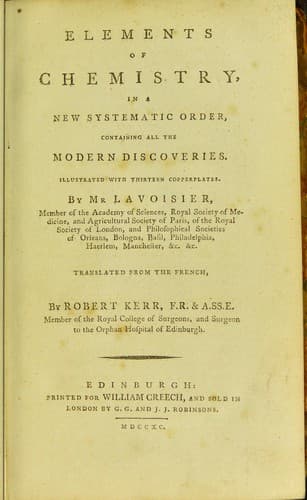
Elements of Chemistry,: In a New Systematic Order, Containing all the Modern DiscoveriesLavoisier, Antoine Laurent
Science
Elements of Chemistry,: In a New Systematic Order, Containing all the Modern Discoveries
Lavoisier, Antoine Laurent
Chemistry -- Early works to 1800
As experiments often produce two, three, or more species of gas, it is
necessary to be able to separate these from each other, that we may
ascertain the quantity and species of each. Suppose that under the jar
A, Pl. IV. Fig. 3. is contained a quantity of different gasses mixed
together, and standing over mercury, we begin by marking with slips of
paper, as before directed, the height at which the mercury stands within
the glass; then introduce about a cubical inch of water into the jar,
which will swim over the surface of the mercury: If the mixture of gas
contains any muriatic or sulphurous acid gas, a rapid and considerable
absorption will instantly take place, from the strong tendency these two
gasses have, especially the former, to combine with, or be absorbed by
water. If the water only produces a slight absorption of gas hardly
equal to its own bulk, we conclude, that the mixture neither contains
muriatic acid, sulphuric acid, or ammoniacal gas, but that it contains
carbonic acid gas, of which water only absorbs about its own bulk. To
ascertain this conjecture, introduce some solution of caustic alkali,
and the carbonic acid gas will be gradually absorbed in the course of a
few hours; it combines with the caustic alkali or potash, and the
remaining gas is left almost perfectly free from any sensible residuum
of carbonic acid gas.
After each experiment of this kind, we must carefully mark the height at
which the mercury stands within the jar, by slips of paper pasted on,
and varnished over when dry, that they may not be washed off when placed
in the water apparatus. It is likewise necessary to register the
difference between the surface of the mercury in the cistern and that in
the jar, and the height of the barometer and thermometer, at the end of
each experiment.
Public-domain text, read in full here on John Shaqi.
Reviews
Reviews
No reviews yet
Be the first to share your thoughts on this work.
Elsewhere in the archive
Join the Discussion
Join the discussion
Sign in to leave a comment or review.
Sign InorCreate an account