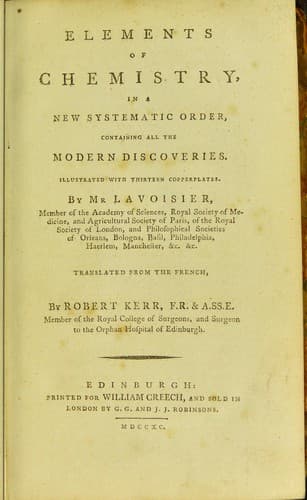
Elements of Chemistry,: In a New Systematic Order, Containing all the Modern DiscoveriesLavoisier, Antoine Laurent
Science
Elements of Chemistry,: In a New Systematic Order, Containing all the Modern Discoveries
Lavoisier, Antoine Laurent
Chemistry -- Early works to 1800
When all the gas or gasses absorbable by water and potash are absorbed,
water is admitted into the jar to displace the mercury; and, as is
described in the preceding section, the mercury in the cistern is to be
covered by one or two inches of water. After this, the jar is to be
transported by means of the flat dish BC, Pl. V. Fig. 9. into the water
apparatus; and the quantity of gas remaining is to be ascertained by
changing it into a graduated jar. After this, small trials of it are to
be made by experiments in little jars, to ascertain nearly the nature of
the gas in question. For instance, into a small jar full of the gas,
Fig. 8. Pl. V. a lighted taper is introduced; if the taper is not
immediately extinguished, we conclude the gas to contain oxygen gas;
and, in proportion to the brightness of the flame, we may judge if it
contain less or more oxygen gas than atmospheric air contains. If, on
the contrary, the taper be instantly extinguished, we have strong reason
to presume that the residuum is chiefly composed of azotic gas. If, upon
the approach of the taper, the gas takes fire and burns quietly at the
surface with a white flame, we conclude it to be pure hydrogen gas; if
this flame is blue, we judge it consists of carbonated hydrogen gas;
and, if it takes fire with a sudden deflagration, that it is a mixture
of oxygen and hydrogen gas. If, again, upon mixing a portion of the
residuum with oxygen gas, red fumes are produced, we conclude that it
contains nitrous gas.
These preliminary trials give some general knowledge of the properties
of the gas, and nature of the mixture, but are not sufficient to
determine the proportions and quantities of the several gasses of which
it is composed. For this purpose all the methods of analysis must be
employed; and, to direct these properly, it is of great use to have a
previous approximation by the above methods. Suppose, for instance, we
know that the residuum consists of oxygen and azotic gas mixed together,
put a determinate quantity, 100 parts, into a graduated tube of ten or
twelve lines diameter, introduce a solution of sulphuret of potash in
contact with the gas, and leave them together for some days; the
sulphuret absorbs the whole oxygen gas, and leaves the azotic gas pure.
Public-domain text, read in full here on John Shaqi.
Reviews
Reviews
No reviews yet
Be the first to share your thoughts on this work.
Elsewhere in the archive
Join the Discussion
Join the discussion
Sign in to leave a comment or review.
Sign InorCreate an account