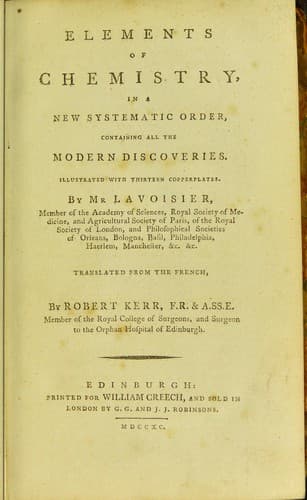
Elements of Chemistry,: In a New Systematic Order, Containing all the Modern DiscoveriesLavoisier, Antoine Laurent
Science
Elements of Chemistry,: In a New Systematic Order, Containing all the Modern Discoveries
Lavoisier, Antoine Laurent
Chemistry -- Early works to 1800
As during evaporation the fluid carried off by caloric is entirely lost,
being sacrificed for the sake of the fixed substances with which it was
combined, this process is only employed where the fluid is of small
value, as water, for instance. But, when the fluid is of more
consequence, we have recourse to distillation, in which process we
preserve both the fixed substance and the volatile fluid. The vessels
employed for evaporation are basons or pans of copper, silver, or lead,
Pl. II. Fig. 13. and 15. or capsules of glass, porcellain, or stone
ware, Pl. II. A, Fig. 1. and 2. Pl. III. Fig. 3 and 4. The best utensils
for this purpose are made of the bottoms of glass retorts and matrasses,
as their equal thinness renders them more fit than any other kind of
glass vessel for bearing a brisk fire and sudden alterations of heat and
cold without breaking.
As the method of cutting these glass vessels is no where described in
books, I shall here give a description of it, that they may be made by
chemists for themselves out of spoiled retorts, matrasses, and
recipients, at a much cheaper rate than any which can be procured from
glass manufacturers. The instrument, Pl. III. Fig. 5. consisting of an
iron ring AC, fixed to the rod AB, having a wooden handle D, is employed
as follows: Make the ring red hot in the fire, and put it upon the
matrass G, Fig. 6. which is to be cut; when the glass is sufficiently
heated, throw on a little cold water, and it will generally break
exactly at the circular line heated by the ring.
Small flasks or phials of thin glass are exceeding good vessels for
evaporating small quantities of fluid; they are very cheap, and stand
the fire remarkably. One or more of these may be placed upon a second
grate above the furnace, Pl. III. Fig. 2. where they will only
experience a gentle heat. By this means a great number of experiments
may be carried on at one time. A glass retort, placed in a sand bath,
and covered with a dome of baked earth, Pl. III. Fig. 1. answers pretty
well for evaporations; but in this way it is always considerably slower,
and is even liable to accidents; as the sand heats unequally, and the
glass cannot dilate in the same unequal manner, the retort is very
liable to break. Sometimes the sand serves exactly the office of the
iron ring formerly mentioned; for, if a single drop of vapour, condensed
into liquid, happens to fall upon the heated part of the vessel, it
breaks circularly at that place. When a very intense fire is necessary,
earthen crucibles may be used; but we generally use the word
_evaporation_ to express what is produced by the temperature of boiling
water, or not much higher.
SECT. IV.
_Of Cristallization._
Public-domain text, read in full here on John Shaqi.
Reviews
Reviews
No reviews yet
Be the first to share your thoughts on this work.
Elsewhere in the archive
Join the Discussion
Join the discussion
Sign in to leave a comment or review.
Sign InorCreate an account