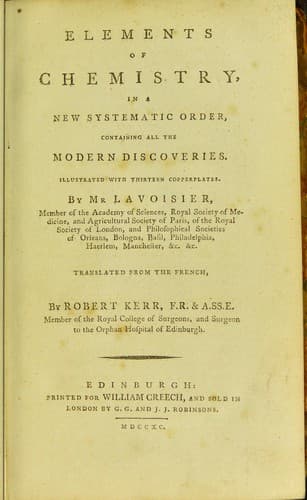
Elements of Chemistry,: In a New Systematic Order, Containing all the Modern DiscoveriesLavoisier, Antoine Laurent
Science
Elements of Chemistry,: In a New Systematic Order, Containing all the Modern Discoveries
Lavoisier, Antoine Laurent
Chemistry -- Early works to 1800
In this process the integrant parts of a solid body, separated from each
other by the intervention of a fluid, are made to exert the mutual
attraction of aggregation, so as to coalesce and reproduce a solid mass.
When the particles of a body are only separated by caloric, and the
substance is thereby retained in the liquid state, all that is necessary
for making it cristallize, is to remove a part of the caloric which is
lodged between its particles, or, in other words, to cool it. If this
refrigeration be slow, and the body be at the same time left at rest,
its particles assume a regular arrangement, and cristallization,
properly so called, takes place; but, if the refrigeration is made
rapidly, or if the liquor be agitated at the moment of its passage to
the concrete state, the cristallization is irregular and confused.
The same phenomena occur with watery solutions, or rather in those made
partly in water, and partly by caloric. So long as there remains a
sufficiency of water and caloric to keep the particles of the body
asunder beyond the sphere of their mutual attraction, the salt remains
in the fluid state; but, whenever either caloric or water is not present
in sufficient quantity, and the attraction of the particles for each
other becomes superior to the power which keeps them asunder, the salt
recovers its concrete form, and the cristals produced are the more
regular in proportion as the evaporation has been slower and more
tranquilly performed.
All the phenomena we formerly mentioned as taking place during the
solution of salts, occur in a contrary sense during their
cristallization. Caloric is disengaged at the instant of their assuming
the solid state, which furnishes an additional proof of salt being held
in solution by the compound action of water and caloric. Hence, to cause
salts to cristallize which readily liquify by means of caloric, it is
not sufficient to carry off the water which held them in solution, but
the caloric united to them must likewise be removed. Nitrat of potash,
oxygenated muriat of potash, alum, sulphat of soda, &c. are examples of
this circumstance, as, to make these salts cristallize, refrigeration
must be added to evaporation. Such salts, on the contrary, as require
little caloric for being kept in solution, and which, from that
circumstance, are nearly equally soluble in cold and warm water, are
cristallizable by simply carrying off the water which holds them in
solution, and even recover their solid state in boiling water; such are
sulphat of lime, muriat of potash and of soda, and several others.
Public-domain text, read in full here on John Shaqi.
Reviews
Reviews
No reviews yet
Be the first to share your thoughts on this work.
Elsewhere in the archive
Join the Discussion
Join the discussion
Sign in to leave a comment or review.
Sign InorCreate an account