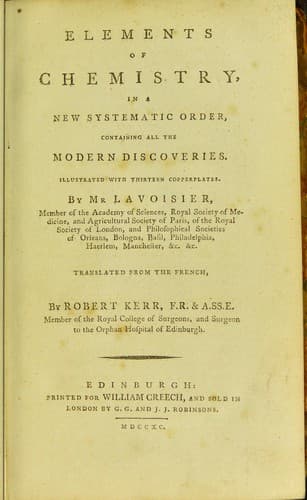
Elements of Chemistry,: In a New Systematic Order, Containing all the Modern DiscoveriesLavoisier, Antoine Laurent
Science
Elements of Chemistry,: In a New Systematic Order, Containing all the Modern Discoveries
Lavoisier, Antoine Laurent
Chemistry -- Early works to 1800
The art of refining saltpetre depends upon these properties of salts,
and upon their different degrees of solubility in hot and cold water.
This salt, as produced in the manufactories by the first operation, is
composed of many different salts; some are deliquescent, and not
susceptible of being cristallized, such as the nitrat and muriat of
lime; others are almost equally soluble in hot and cold water, as the
muriats of potash and of soda; and, lastly, the saltpetre, or nitrat of
potash, is greatly more soluble in hot than it is in cold water. The
operation is begun, by pouring upon this mixture of salts as much water
as will hold even the least soluble, the muriats of soda and of potash,
in solution; so long as it is hot, this quantity readily dissolves all
the saltpetre, but, upon cooling, the greater part of this salt
cristallizes, leaving about a sixth part remaining dissolved, and mixed
with the nitrat of lime and the two muriats. The nitre obtained by this
process is still somewhat impregnated with other salts, because it has
been cristallized from water in which these abound: It is completely
purified from these by a second solution in a small quantity of boiling
water, and second cristallization. The water remaining after these
cristallizations of nitre is still loaded with a mixture of saltpetre,
and other salts; by farther evaporation, crude saltpetre, or
rough-petre, as the workmen call it, is procured from it, and this is
purified by two fresh solutions and cristallizations.
The deliquescent earthy salts which do not contain the nitric acid are
rejected in this manufacture; but those which consist of that acid
neutralized by an earthy base are dissolved in water, the earth is
precipitated by means of potash, and allowed to subside; the clear
liquor is then decanted, evaporated, and allowed to cristallize. The
above management for refining saltpetre may serve as a general rule for
separating salts from each other which happen to be mixed together. The
nature of each must be considered, the proportion in which each
dissolves in given quantities of water, and the different solubility of
each in hot and cold water. If to these we add the property which some
salts possess, of being soluble in alkohol, or in a mixture of alkohol
and water, we have many resources for separating salts from each other
by means of cristallization, though it must be allowed that it is
extremely difficult to render this separation perfectly complete.
The vessels used for cristallization are pans of earthen ware, A, Pl.
II. Fig. 1. and 2. and large flat dishes, Pl. III. Fig. 7. When a saline
solution is to be exposed to a slow evaporation in the heat of the
atmosphere, with free access of air, vessels of some depth, Pl. III.
Fig. 3. must be employed, that there may be a considerable body of
liquid; by this means the cristals produced are of considerable size,
and remarkably regular in their figure.
Public-domain text, read in full here on John Shaqi.
Reviews
Reviews
No reviews yet
Be the first to share your thoughts on this work.
Elsewhere in the archive
Join the Discussion
Join the discussion
Sign in to leave a comment or review.
Sign InorCreate an account