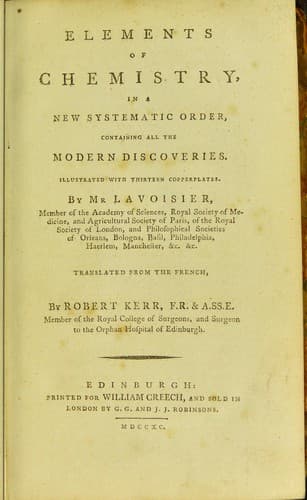
Elements of Chemistry,: In a New Systematic Order, Containing all the Modern DiscoveriesLavoisier, Antoine Laurent
Science
Elements of Chemistry,: In a New Systematic Order, Containing all the Modern Discoveries
Lavoisier, Antoine Laurent
Chemistry -- Early works to 1800
Every species of salt cristallizes in a peculiar form, and even each
salt varies in the form of its cristals according to circumstances,
which take place during cristallization. We must not from thence
conclude that the saline particles of each species are indeterminate in
their figures: The primative particles of all bodies, especially of
salts, are perfectly constant in their specific forms; but the cristals
which form in our experiments are composed of congeries of minute
particles, which, though perfectly equal in size and shape, may assume
very dissimilar arrangements, and consequently produce a vast variety of
regular forms, which have not the smallest apparent resemblance to each
other, nor to the original cristal. This subject has been very ably
treated by the Abbe Hauey, in several memoirs presented to the Academy,
and in his work upon the structure of cristals: It is only necessary to
extend generally to the class of salts the principles he has
particularly applied to some cristalized stones.
SECT. V.
_Of Simple Distillation._
As distillation has two distinct objects to accomplish, it is divisible
into simple and compound; and, in this section, I mean to confine myself
entirely to the former. When two bodies, of which one is more volatile
than the other, or has more affinity to caloric, are submitted to
distillation, our intention is to separate them from each other: The
more volatile substance assumes the form of gas, and is afterwards
condensed by refrigeration in proper vessels. In this case distillation,
like evaporation, becomes a species of mechanical operation, which
separates two substances from each other without decomposing or altering
the nature of either. In evaporation, our only object is to preserve the
fixed body, without paying any regard to the volatile matter; whereas,
in distillation, our principal attention is generally paid to the
volatile substance, unless when we intend to preserve both the one and
the other. Hence, simple distillation is nothing more than evaporation
produced in close vessels.
Public-domain text, read in full here on John Shaqi.
Reviews
Reviews
No reviews yet
Be the first to share your thoughts on this work.
Elsewhere in the archive
Join the Discussion
Join the discussion
Sign in to leave a comment or review.
Sign InorCreate an account