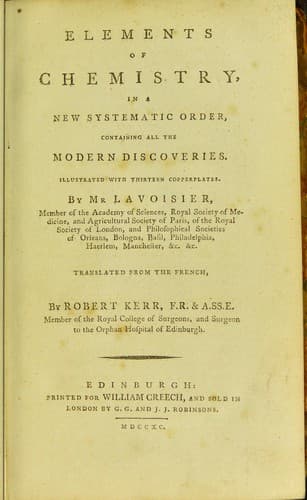
Elements of Chemistry,: In a New Systematic Order, Containing all the Modern DiscoveriesLavoisier, Antoine Laurent
Science
Elements of Chemistry,: In a New Systematic Order, Containing all the Modern Discoveries
Lavoisier, Antoine Laurent
Chemistry -- Early works to 1800
As glass or earthen vessels are very brittle, and do not readily bear
sudden alterations of heat and cold, every well regulated laboratory
ought to have one or more alembics of metal for distilling water,
spiritous liquors, essential oils, &c. This apparatus consists of a
cucurbit and capital of tinned copper or brass, Pl. III. Fig. 15. and
16. which, when judged proper, may be placed in the water bath, D, Fig.
17. In distillations, especially of spiritous liquors, the capital must
be furnished with a refrigetory, SS, Fig. 16. kept continually filled
with cold water; when the water becomes heated, it is let off by the
stop-cock, R, and renewed with a fresh supply of cold water. As the
fluid distilled is converted into gas by means of caloric furnished by
the fire of the furnace, it is evident that it could not condense, and,
consequently, that no distillation, properly speaking, could take place,
unless it is made to deposit in the capital all the caloric it received
in the cucurbit; with this view, the sides of the capital must always be
preserved at a lower temperature than is necessary for keeping the
distilling substance in the state of gas, and the water in the
refrigetory is intended for this purpose. Water is converted into gas
by the temperature of 80 deg. (212 deg.), alkohol by 67 deg. (182.75
deg.), ether by 32 deg. (104 deg.); hence these substances cannot be
distilled, or, rather, they will fly off in the state of gas, unless
the temperature of the refrigetory be kept under these respective
degrees.
In the distillation of spiritous, and other expansive liquors, the above
described refrigetory is not sufficient for condensing all the vapours
which arise; in this case, therefore, instead of receiving the distilled
liquor immediately from the beak, TU, of the capital into a recipient, a
worm is interposed between them. This instrument is represented Pl. III.
Fig. 18. contained in a worm tub of tinned copper, it consists of a
metallic tube bent into a considerable number of spiral revolutions. The
vessel which contains the worm is kept full of cold water, which is
renewed as it grows warm. This contrivance is employed in all
distilleries of spirits, without the intervention of a capital and
refrigetory, properly so called. The one represented in the plate is
furnished with two worms, one of them being particularly appropriated to
distillations of odoriferous substances.
In some simple distillations it is necessary to interpose an adopter
between the retort and receiver, as shown Pl. III. Fig, 11. This may
serve two different purposes, either to separate two products of
different degrees of volatility, or to remove the receiver to a greater
distance from the furnace, that it may be less heated. But these, and
several other more complicated instruments of ancient contrivance, are
far from producing the accuracy requisite in modern chemistry, as will
be readily perceived when I come to treat of compound distillation.
SECT. VI.
Public-domain text, read in full here on John Shaqi.
Reviews
Reviews
No reviews yet
Be the first to share your thoughts on this work.
Elsewhere in the archive
Join the Discussion
Join the discussion
Sign in to leave a comment or review.
Sign InorCreate an account