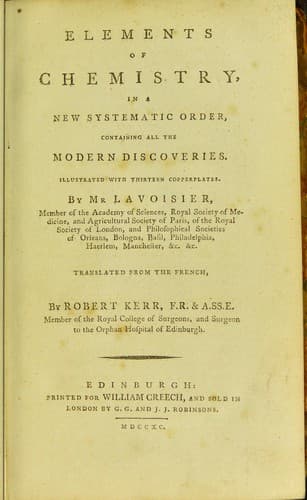
Elements of Chemistry,: In a New Systematic Order, Containing all the Modern DiscoveriesLavoisier, Antoine Laurent
Science
Elements of Chemistry,: In a New Systematic Order, Containing all the Modern Discoveries
Lavoisier, Antoine Laurent
Chemistry -- Early works to 1800
This first object of lutes is very well accomplished by bees wax, melted
with about an eighth part of turpentine. This lute is very easily
managed, sticks very closely to glass, and is very difficultly
penetrable; it may be rendered more consistent, and less or more hard or
pliable, by adding different kinds of resinous matters. Though this
species of lute answers extremely well for retaining gasses and vapours,
there are many chemical experiments which produce considerable heat, by
which this lute becomes liquified, and consequently the expansive
vapours must very readily force through and escape.
For such cases, the following fat lute is the best hitherto discovered,
though not without its disadvantages, which shall be pointed out. Take
very pure and dry unbaked clay, reduced to a very fine powder, put this
into a brass mortar, and beat it for several hours with a heavy iron
pestle, dropping in slowly some boiled lintseed oil; this is oil which
has been oxygenated, and has acquired a drying quality, by being boiled
with litharge. This lute is more tenacious, and applies better, if amber
varnish be used instead of the above oil. To make this varnish, melt
some yellow amber in an iron laddle, by which operation it loses a part
of its succinic acid, and essential oil, and mix it with lintseed oil.
Though the lute prepared with this varnish is better than that made with
boiled oil, yet, as its additional expence is hardly compensated by its
superior quality, it is seldom used.
The above fat lute is capable of sustaining a very violent degree of
heat, is impenetrable by acids and spiritous liquors, and adheres
exceedingly well to metals, stone ware, or glass, providing they have
been previously rendered perfectly dry. But if, unfortunately, any of
the liquor in the course of an experiment gets through, either between
the glass and the lute, or between the layers of the lute itself, so as
to moisten the part, it is extremely difficult to close the opening.
This is the chief inconvenience which attends the use of fat lute, and
perhaps the only one it is subject to. As it is apt to soften by heat,
we must surround all the junctures with slips of wet bladder applied
over the luting, and fixed on by pack-thread tied round both above and
below the joint; the bladder, and consequently the lute below, must be
farther secured by a number of turns of pack-thread all over it. By
these precautions, we are free from every danger of accident; and the
junctures secured in this manner may be considered, in experiments, as
hermetically sealed.
Public-domain text, read in full here on John Shaqi.
Reviews
Reviews
No reviews yet
Be the first to share your thoughts on this work.
Elsewhere in the archive
Join the Discussion
Join the discussion
Sign in to leave a comment or review.
Sign InorCreate an account