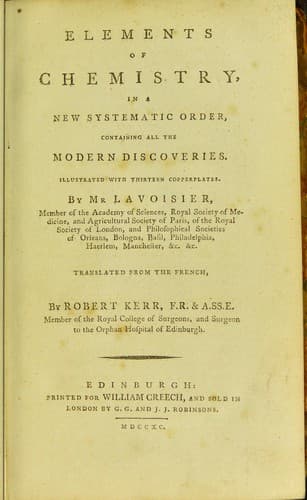
Elements of Chemistry,: In a New Systematic Order, Containing all the Modern DiscoveriesLavoisier, Antoine Laurent
Science
Elements of Chemistry,: In a New Systematic Order, Containing all the Modern Discoveries
Lavoisier, Antoine Laurent
Chemistry -- Early works to 1800
It frequently happens that the figure of the junctures prevents the
application of ligatures, which is the case with the three-necked
bottles formerly described; and it even requires great address to apply
the twine without shaking the apparatus; so that, where a number of
junctures require luting, we are apt to displace several while securing
one. In these cases, we may substitute slips of linen, spread with white
of egg and lime mixed together, instead of the wet bladder. These are
applied while still moist, and very speedily dry and acquire
considerable hardness. Strong glue dissolved in water may answer instead
of white of egg. These fillets are usefully applied likewise over
junctures luted together with wax and rosin.
Before applying a lute, all the junctures of the vessels must be
accurately and firmly fitted to each other, so as not to admit of being
moved. If the beak of a retort is to be luted to the neck of a
recipient, they ought to fit pretty accurately; otherwise we must fix
them, by introducing short pieces of soft wood or of cork. If the
disproportion between the two be very considerable, we must employ a
cork which fits the neck of the recipient, having a circular hole of
proper dimensions to admit the beak of the retort. The same precaution
is necessary in adapting bent tubes to the necks of bottles in the
apparatus represented Pl. IV. Fig. 1. and others of a similar nature.
Each mouth of each bottle must be fitted with a cork, having a hole made
with a round file of a proper size for containing the tube. And, when
one mouth is intended to admit two or more tubes, which frequently
happens when we have not a sufficient number of bottles with two or
three necks, we must use a cork with two or three holes, Pl. IV. Fig. 8.
When the whole apparatus is thus solidly joined, so that no part can
play upon another, we begin to lute. The lute is softened by kneading
and rolling it between the fingers, with the assistance of heat, if
necessary. It is rolled into little cylindrical pieces, and applied to
the junctures, taking great care to make it apply close, and adhere
firmly, in every part; a second roll is applied over the first, so as to
pass it on each side, and so on till each juncture be sufficiently
covered; after this, the slips of bladder, or of linen, as above
directed, must be carefully applied over all. Though this operation may
appear extremely simple, yet it requires peculiar delicacy and
management; great care must be taken not to disturb one juncture whilst
luting another, and more especially when applying the fillets and
ligatures.
Public-domain text, read in full here on John Shaqi.
Reviews
Reviews
No reviews yet
Be the first to share your thoughts on this work.
Elsewhere in the archive
Join the Discussion
Join the discussion
Sign in to leave a comment or review.
Sign InorCreate an account