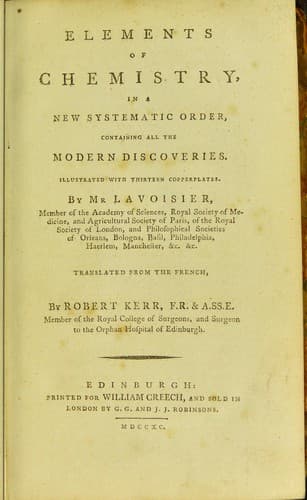
Elements of Chemistry,: In a New Systematic Order, Containing all the Modern DiscoveriesLavoisier, Antoine Laurent
Science
Elements of Chemistry,: In a New Systematic Order, Containing all the Modern Discoveries
Lavoisier, Antoine Laurent
Chemistry -- Early works to 1800
Take a large balloon, A, Pl. IV. Fig. 4. of cristal or white glass, with
an opening, EF, about two inches and a half, or three inches, diameter,
to which a cap of brass is accurately fitted with emery, and which has
two holes for the passage of the tubes xxx, yyy. Before shutting the
balloon with its cover, place within it the stand, BC, supporting the
cup of porcelain, D, which contains the phosphorus. Then lute on the cap
with fat lute, and allow it to dry for some days, and weigh the whole
accurately; after this exhaust the balloon by means of an air-pump
connected with the tube xxx, and fill it with oxygen gas by the tube
yyy, from the gazometer, Pl. VIII. Fig. 1. described Chap. II. Sect
II. of this part. The phosphorus is then set on fire by means of a
burning-glass, and is allowed to burn till the cloud of concrete
phosphoric acid stops the combustion, oxygen gas being continually
supplied from the gazometer. When the apparatus has cooled, it is
weighed and unluted; the tare of the instrument being allowed, the
weight is that of the phosphoric acid contained. It is proper, for
greater accuracy, to examine the air or gas contained in the balloon
after combustion, as it may happen to be somewhat heavier or lighter
than common air; and this difference of weight must be taken into
account in the calculations upon the results of the experiment.
SECT. III.
_Of the Combustion of Charcoal._
The apparatus I have employed for this process consists of a small
conical furnace of hammered copper, represented in perspective, Pl. XII.
Fig. 9. and internally displayed Fig. 11. It is divided into the
furnace, ABC, where the charcoal is burnt, the grate, d e, and the
ash-hole, F; the tube, GH, in the middle of the dome of the furnace
serves to introduce the charcoal, and as a chimney for carrying off the
air which has served for combustion. Through the tube, l m n, which
communicates with the gazometer, the hydrogen gas, or air, intended for
supporting the combustion, is conveyed into the ash-hole, F, whence it
is forced, by the application of pressure to the gazometer, to pass
through the grate, d e, and to blow upon the burning charcoal placed
immediately above.
Oxygen gas, which forms 28/100 of atmospheric air, is changed into
carbonic acid gas during combustion with charcoal, whilst the azotic gas
of the air is not altered at all. Hence, after the combustion of
charcoal in atmospheric air, a mixture of carbonic acid gas and azotic
gas must remain; to allow this mixture to pass off, the tube, o p, is
adapted to the chimney, GH, by means of a screw at G, and conveys the
gas into bottles half filled with solution of caustic potash. The
carbonic acid gas is absorbed by the alkali, and the azotic gas is
conveyed into a second gazometer, where its quantity is ascertained.
Public-domain text, read in full here on John Shaqi.
Reviews
Reviews
No reviews yet
Be the first to share your thoughts on this work.
Elsewhere in the archive
Join the Discussion
Join the discussion
Sign in to leave a comment or review.
Sign InorCreate an account