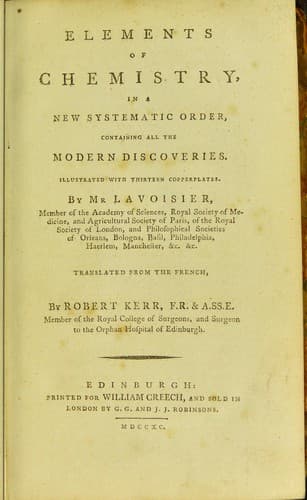
Elements of Chemistry,: In a New Systematic Order, Containing all the Modern DiscoveriesLavoisier, Antoine Laurent
Science
Elements of Chemistry,: In a New Systematic Order, Containing all the Modern Discoveries
Lavoisier, Antoine Laurent
Chemistry -- Early works to 1800
The weight of the furnace, ABC, is first accurately determined, then
introduce the tube RS, of known weight, by the chimney, GH, till its
lower end S, rests upon the grate, d e, which it occupies entirely; in
the next place, fill the furnace with charcoal, and weigh the whole
again, to know the exact quantity of charcoal submitted to experiment.
The furnace is now put in its place, the tube, l m n, is screwed to
that which communicates with the gazometer, and the tube, o p, to that
which communicates with the bottles of alkaline solution. Every thing
being in readiness, the stop-cock of the gazometer is opened, a small
piece of burning charcoal is thrown into the tube, RS, which is
instantly withdrawn, and the tube, o p, is screwed to the chimney, GH.
The little piece of charcoal falls upon the grate, and in this manner
gets below the whole charcoal, and is kept on fire by the stream of air
from the gazometer. To be certain that the combustion is begun, and goes
on properly, the tube, q r s, is fixed to the furnace, having a piece
of glass cemented to its upper extremity, s, through which we can see
if the charcoal be on fire.
I neglected to observe above, that the furnace, and its appendages, are
plunged in water in the cistern, TVXY, Fig. 11. Pl. XII. to which ice
may be added to moderate the heat, if necessary; though the heat is by
no means very considerable, as there is no air but what comes from the
gazometer, and no more of the charcoal burns at one time than what is
immediately over the grate.
As one piece of charcoal is consumed another falls down into its place,
in consequence of the declivity of the sides of the furnace; this gets
into the stream of air from the grate, d e, and is burnt; and so on,
successively, till the whole charcoal is consumed. The air which has
served the purpose of the combustion passes through the mass of
charcoal, and is forced by the pressure of the gazometer to escape
through the tube, o p, and to pass through the bottles of alkaline
solution.
This experiment furnishes all the necessary data for a complete analysis
of atmospheric air and of charcoal. We know the weight of charcoal
consumed; the gazometer gives us the measure of the air employed; the
quantity and quality of gas remaining after combustion may be
determined, as it is received, either in another gazometer, or in jars,
in a pneumato-chemical apparatus; the weight of ashes remaining in the
ash-hole is readily ascertained; and, finally, the additional weight
acquired by the bottles of alkaline solution gives the exact quantity of
carbonic acid formed during the process. By this experiment we may
likewise determine, with sufficient accuracy, the proportions in which
charcoal and oxygen enter into the composition of carbonic acid.
Public-domain text, read in full here on John Shaqi.
Reviews
Reviews
No reviews yet
Be the first to share your thoughts on this work.
Elsewhere in the archive
Join the Discussion
Join the discussion
Sign in to leave a comment or review.
Sign InorCreate an account