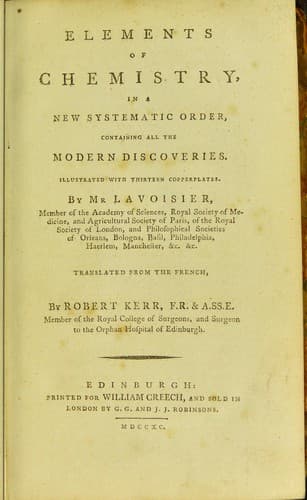
Elements of Chemistry,: In a New Systematic Order, Containing all the Modern DiscoveriesLavoisier, Antoine Laurent
Science
Elements of Chemistry,: In a New Systematic Order, Containing all the Modern Discoveries
Lavoisier, Antoine Laurent
Chemistry -- Early works to 1800
In a future memoir I shall give an account to the Academy of a series of
experiments I have undertaken, with this instrument, upon all the
vegetable and animal charcoals. By some very slight alterations, this
machine may be made to answer for observing the principal phenomena of
respiration.
SECT. IV.
_Of the Combustion of Oils._
Oils are more compound in their nature than charcoal, being formed by
the combination of at least two elements, charcoal and hydrogen; of
course, after their combustion in common air, water, carbonic acid gas,
and azotic gas, remain. Hence the apparatus employed for their
combustion requires to be adapted for collecting these three products,
and is consequently more complicated than the charcoal furnace.
The apparatus I employ for this purpose is composed of a large jar or
pitcher A, Pl. XII. Fig. 4. surrounded at its upper edge by a rim of
iron properly cemented at DE, and receding from the jar at BC, so as to
leave a furrow or gutter xx, between it and the outside of the jar,
somewhat more than two inches deep. The cover or lid of the jar, Fig. 5.
is likewise surrounded by an iron rim f g, which adjusts into the
gutter xx, Fig. 4. which being filled with mercury, has the effect of
closing the jar hermetically in an instant, without using any lute; and,
as the gutter will hold about two inches of mercury, the air in the jar
may be made to sustain the pressure of more than two feet of water,
without danger of its escaping.
The lid has four holes, T h i k, for the passage of an equal
number of tubes. The opening T is furnished with a leather box, through
which passes the rod, Fig. 3. intended for raising and lowering the wick
of the lamp, as will be afterwards directed. The three other holes are
intended for the passage of three several tubes, one of which conveys
the oil to the lamp, a second conveys air for keeping up the combustion,
and the third carries off the air, after it has served for combustion.
The lamp in which the oil is burnt is represented Fig. 2; a is the
reservoir of oil, having a funnel by which it is filled; b c d e f g h
is a syphon which conveys the oil to the lamp 11; 7, 8, 9, 10, is the
tube which conveys the air for combustion from the gazometer to the same
lamp. The tube b c is formed externally, at its lower end b, into a
male screw, which turns in a female screw in the lid of the reservoir of
oil a; so that, by turning the reservoir one way or the other, it is
made to rise or fall, by which the oil is kept at the necessary level.
Public-domain text, read in full here on John Shaqi.
Reviews
Reviews
No reviews yet
Be the first to share your thoughts on this work.
Elsewhere in the archive
Join the Discussion
Join the discussion
Sign in to leave a comment or review.
Sign InorCreate an account