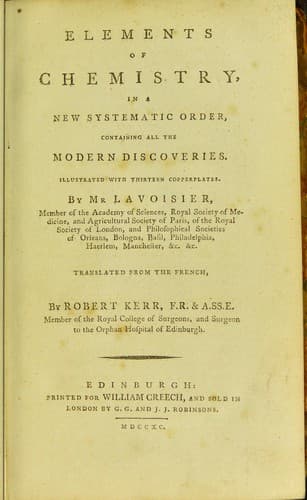
Elements of Chemistry,: In a New Systematic Order, Containing all the Modern DiscoveriesLavoisier, Antoine Laurent
Science
Elements of Chemistry,: In a New Systematic Order, Containing all the Modern Discoveries
Lavoisier, Antoine Laurent
Chemistry -- Early works to 1800
When the syphon is to be filled, and the communication formed between
the reservoir of oil and the lamp, the stop-cock c is shut, and that
at e opened, oil is poured in by the opening f at the top of the
syphon, till it rises within three or four lines of the upper edge of
the lamp, the stop-cock k is then shut, and that at c opened; the
oil is then poured in at f, till the branch b c d of the syphon is
filled, and then the stop-cock e is closed. The two branches of the
syphon being now completely filled, a communication is fully established
between the reservoir and the lamp.
In Pl. XII. Fig. 1. all the parts of the lamp 11, Fig. 2. are
represented magnified, to show them distinctly. The tube i k carries
the oil from the reservoir to the cavity a a a a, which contains the
wick; the tube 9, 10, brings the air from the gazometer for keeping up
the combustion; this air spreads through the cavity d d d d, and, by
means of the passages c c c c and b b b b, is distributed on each
side of the wick, after the principles of the lamps constructed by
Argand, Quinquet, and Lange.
To render the whole of this complicated apparatus more easily
understood, and that its description may make all others of the same
kind more readily followed, it is represented, completely connected
together for use, in Pl. XI. The gazometer P furnishes air for the
combustion by the tube and stop-cock 1, 2; the tube 2, 3, communicates
with a second gazometer, which is filled whilst the first one is
emptying during the process, that there may be no interruption to the
combustion; 4, 5, is a tube of glass filled with deliquescent salts, for
drying the air as much as possible in its passage; and the weight of
this tube and its contained salts, at the beginning of the experiment,
being known, it is easy to determine the quantity of water absorbed by
them from the air. From this deliquescent tube the air is conducted
through the pipe 5, 6, 7, 8, 9, 10, to the lamp 11, where it spreads on
both sides of the wick, as before described, and feeds the flame. One
part of this air, which serves to keep up the combustion of the oil,
forms carbonic acid gas and water, by oxygenating its elements. Part of
this water condenses upon the sides of the pitcher A, and another part
is held in solution in the air by means of caloric furnished by the
combustion. This air is forced by the compression of the gazometer to
pass through the tube 12, 13, 14, 15, into the bottle 16, and the worm
17, 18, where the water is fully condensed from the refrigeration of the
air; and, if any water still remains in solution, it is absorbed by
deliquescent salts contained in the tube 19, 20.
Public-domain text, read in full here on John Shaqi.
Reviews
Reviews
No reviews yet
Be the first to share your thoughts on this work.
Elsewhere in the archive
Join the Discussion
Join the discussion
Sign in to leave a comment or review.
Sign InorCreate an account