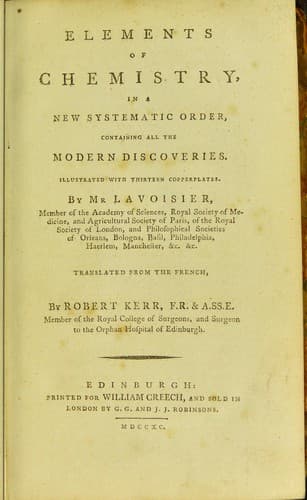
Elements of Chemistry,: In a New Systematic Order, Containing all the Modern DiscoveriesLavoisier, Antoine Laurent
Science
Elements of Chemistry,: In a New Systematic Order, Containing all the Modern Discoveries
Lavoisier, Antoine Laurent
Chemistry -- Early works to 1800
I make use of pistol barrels, about six inches long, and of five or six
lines diameter, having the touch-hole spiked up with an iron nail
strongly driven in, and broken in the hole, and a little tin-smith's
solder run in to prevent any possible issue for the air. These are
charged with a mixture of known quantities of nitre and charcoal, or any
other mixture capable of deflagration, reduced to an impalpable powder,
and formed into a paste with a moderate quantity of water. Every portion
of the materials introduced must be rammed down with a rammer nearly of
the same caliber with the barrel, four or five lines at the muzzle must
be left empty, and about two inches of quick match are added at the end
of the charge. The only difficulty in this experiment, especially when
sulphur is contained in the mixture, is to discover the proper degree of
moistening; for, if the paste be too much wetted, it will not take fire,
and if too dry, the deflagration is apt to become too rapid, and even
dangerous.
When the experiment is not intended to be rigorously exact, we set fire
to the match, and, when it is just about to communicate with the charge,
we plunge the pistol below a large bell-glass full of water, in the
pneumato chemical apparatus. The deflagration begins, and continues in
the water, and gas is disengaged with less or more rapidity, in
proportion as the mixture is more or less dry. So long as the
deflagration continues, the muzzle of the pistol must be kept somewhat
inclined downwards, to prevent the water from getting into its barrel.
In this manner I have sometimes collected the gas produced from the
deflagration of an ounce and half, or two ounces, of nitre.
In this manner of operating it is impossible to determine the quantity
of carbonic acid gas disengaged, because a part of it is absorbed by the
water while passing through it; but, when the carbonic acid is absorbed,
the azotic gas remains; and, if it be agitated for a few minutes in
caustic alkaline solution, we obtain it pure, and can easily determine
its volume and weight. We may even, in this way, acquire a tollerably
exact knowledge of the quantity of carbonic acid by repeating the
experiment a great many times, and varying the proportions of charcoal,
till we find the exact quantity requisite to deflagrate the whole nitre
employed. Hence, by means of the weight of charcoal employed, we
determine the weight of oxygen necessary for saturation, and deduce the
quantity of oxygen contained in a given weight of nitre.
Public-domain text, read in full here on John Shaqi.
Reviews
Reviews
No reviews yet
Be the first to share your thoughts on this work.
Elsewhere in the archive
Join the Discussion
Join the discussion
Sign in to leave a comment or review.
Sign InorCreate an account