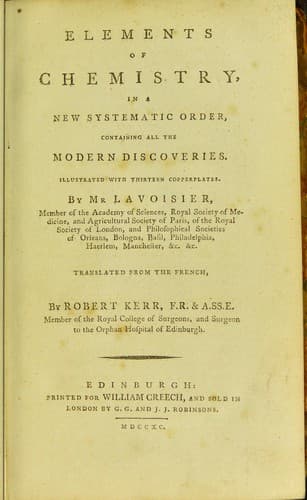
Elements of Chemistry,: In a New Systematic Order, Containing all the Modern DiscoveriesLavoisier, Antoine Laurent
Science
Elements of Chemistry,: In a New Systematic Order, Containing all the Modern Discoveries
Lavoisier, Antoine Laurent
Chemistry -- Early works to 1800
I have used another process, by which the results of this experiment are
considerably more accurate, which consists in receiving the disengaged
gasses in bell-glasses filled with mercury. The mercurial apparatus I
employ is large enough to contain jars of from twelve to fifteen pints
in capacity, which are not very readily managed when full of mercury,
and even require to be filled by a particular method. When the jar is
placed in the cistern of mercury, a glass syphon is introduced,
connected with a small air-pump, by means of which the air is exhausted,
and the mercury rises so as to fill the jar. After this, the gas of the
deflagration is made to pass into the jar in the same manner as directed
when water is employed.
I must again repeat, that this species of experiment requires to be
performed with the greatest possible precautions. I have sometimes seen,
when the disengagement of gas proceeded with too great rapidity, jars
filled with more than an hundred and fifty pounds of mercury driven off
by the force of the explosion, and broken to pieces, while the mercury
was scattered about in great quantities.
When the experiment has succeeded, and the gas is collected under the
jar, its quantity in general, and the nature and quantities of the
several species of gasses of which the mixture is composed, are
accurately ascertained by the methods already pointed out in the second
chapter of this part of my work. I have been prevented from putting the
last hand to the experiments I had begun upon deflagration, from their
connection with the objects I am at present engaged in; and I am in
hopes they will throw considerable light upon the operations belonging
to the manufacture of gun-powder.
CHAP. X.
_Of the Instruments necessary for Operating upon Bodies in very high
Temperatures._
SECT. I.
_Of Fusion._
We have already seen, that, by aqueous solution, in which the particles
of bodies are separated from each other, neither the solvent nor the
body held in solution are at all decomposed; so that, whenever the cause
of separation ceases, the particles reunite, and the saline substance
recovers precisely the same appearance and properties it possessed
before solution. Real solutions are produced by fire, or by introducing
and accumulating a great quantity of caloric between the particles of
bodies; and this species of solution in caloric is usually called
_fusion_.
Public-domain text, read in full here on John Shaqi.
Reviews
Reviews
No reviews yet
Be the first to share your thoughts on this work.
Elsewhere in the archive
Join the Discussion
Join the discussion
Sign in to leave a comment or review.
Sign InorCreate an account